TenderKosh for EPC teams
Turn tender reading into faster bidding decisions.
Discover relevant tenders, monitor corrigenda, compare opportunities, and move from document reading to structured action.
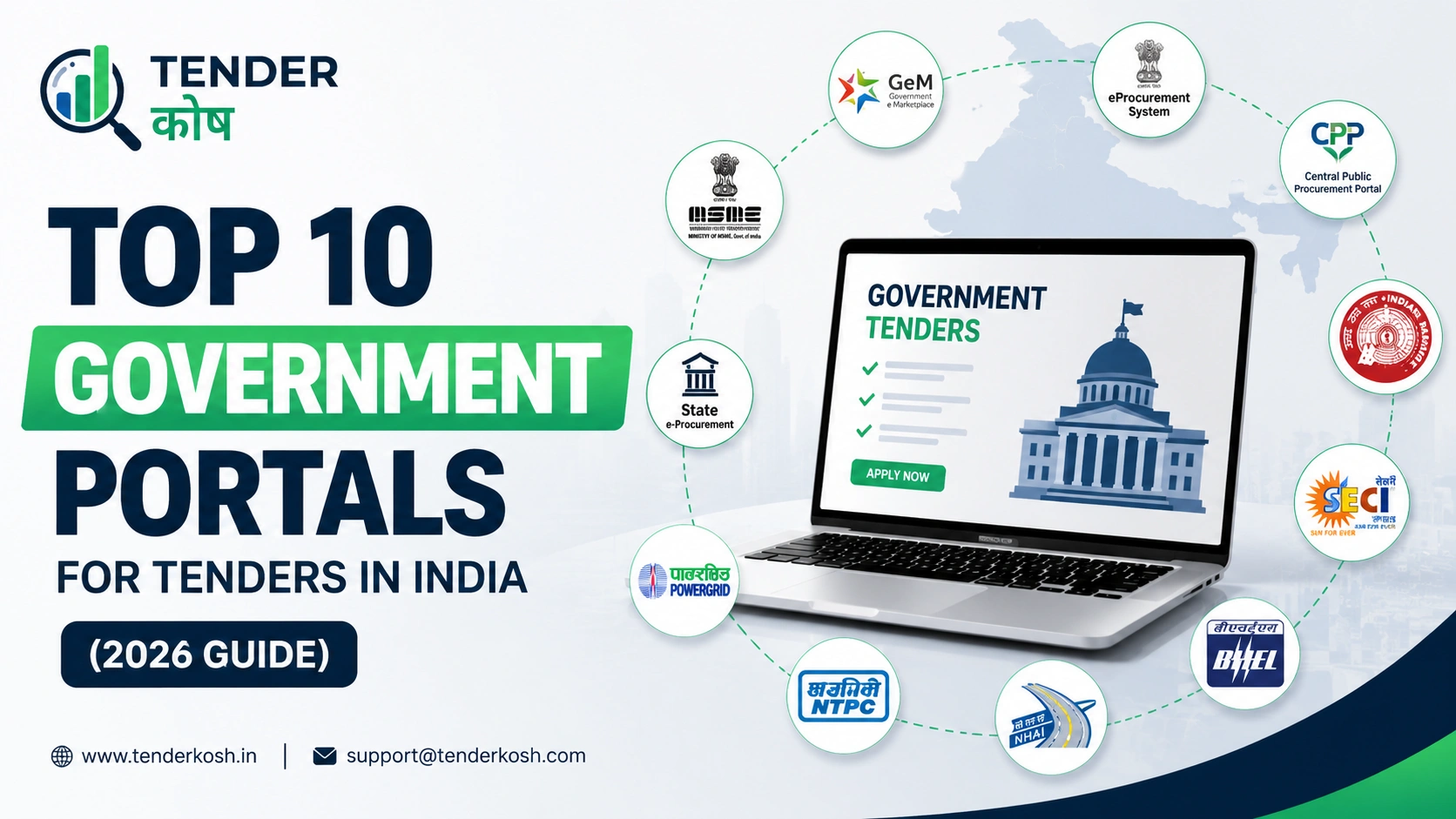
There is no single national portal where every Indian government tender is published. Central ministries and PSUs use CPPP and GeM, Railways uses IREPS, Defence has its own system, and every state runs its own e-procurement portal.
The ten portals below cover the large majority of government work published in India. Learn where your sector’s tenders live, then use an aggregator to monitor all of them from one place instead of refreshing a dozen websites a day.
If you bid for government contracts in India, your biggest risk isn’t losing on price — it’s never seeing the right tender in time. Because opportunities are scattered across central, railway, defence, PSU, and state portals, a contractor working across sectors and states has to watch several websites just to know what’s open this week. This guide lists the ten government portals for tenders that matter most, what each one covers, and a faster way to track them all at once.
Key Takeaways
India’s public procurement is federal and sector-specific by design, so there is no single board where every tender lives. Central ministries, state departments, PSUs, Railways, defence, and municipal bodies each run their own procurement system.
This means a business that bids across sectors or states must watch several portals in parallel — and each publishes on its own schedule, with its own registration, and often with no proactive notification when a new tender or a corrigendum appears. The practical consequence is simple: the bidders who win consistently are the ones who see the full field early, not necessarily the ones with the sharpest pricing. Knowing which government portals for tenders matter to your line of work is the first step; tracking them efficiently is the second.
These ten cover the large majority of government tenders published in India, across central, sector-specific, and state procurement. Register on the ones that match your sector and geography.
The closest thing India has to a national tender board. Managed by NIC, CPPP is the central e-tendering platform where ministries, departments, and central PSUs publish tenders and run the full bid process online.
Best for: central ministries, PSUs, high-value works, supplies, and services.
India’s national public procurement marketplace for common-use goods and services, with catalogue buying, L1 bidding, and reverse auctions. Widely used by government buyers of all sizes, and strong on MSME participation.
Best for: goods, supplies, and services sellers, especially MSMEs and OEMs.
The dedicated portal for Indian Railways — one of India’s largest procurement agencies — covering goods, works, and services tenders across railway zones and production units.
Best for: railway supply, works, and services contractors.
The e-procurement system used by defence organisations for their tenders. A key portal for suppliers and contractors serving the defence ecosystem.
Best for: defence suppliers, equipment, and works.
The Central Public Works Department’s tendering platform for construction, maintenance, and civil works of central government buildings and infrastructure.
Best for: civil works and building construction contractors.
The National Highways Authority of India publishes its EPC, HAM, and O&M tenders through the central e-procurement system. A major source of large infrastructure work.
Best for: highway EPC, HAM, and maintenance contractors. See our NHAI eligibility guide.
Most Indian states run e-procurement portals built on NIC’s GePNIC platform, publishing tenders from state departments, boards, corporations, and local bodies. This is where the bulk of state-level work appears.
Best for: state departments, municipal, and local-body tenders.
Maharashtra’s state e-procurement portal, one of the largest by tender volume. Illustrative of the major state portals every regional bidder should register on for their own state (UP, Karnataka, and others run equivalents).
Best for: Maharashtra state and local tenders (register on your own state’s equivalent).
Large public sector undertakings — in energy, oil & gas, power, and heavy industry — often run their own e-procurement portals in addition to publishing on CPPP. Sector bidders should track the specific PSUs they serve.
Best for: energy, power, oil & gas, and heavy-industry suppliers and contractors.
For solar and renewable EPC, agencies like SECI, NTPC, and state DISCOMs publish major tenders through their own sites and CPPP. Essential for anyone in the renewable-energy supply chain.
Best for: solar/renewable EPC, developers, and equipment suppliers.
URLs change — always confirm the official domain. Government portal addresses and structures are occasionally updated. Before registering or bidding, confirm you’re on the official “.gov.in” site for that authority, and never enter credentials or make payments on look-alike third-party pages.
Here are the ten government portals for tenders side by side, so you can quickly see which to register on for your sector.
| Portal | Primary Coverage | Best For |
|---|---|---|
| CPPP (eprocure.gov.in) | Central ministries, departments, PSUs | Works, supplies, services nationwide |
| GeM (gem.gov.in) | Common-use goods & services marketplace | Goods/services sellers, MSMEs |
| IREPS (ireps.gov.in) | Indian Railways | Railway goods, works, services |
| Defence e-Proc | Defence organisations | Defence suppliers & works |
| CPWD | Central public works & buildings | Civil works contractors |
| NHAI (via CPPP) | National highways | Highway EPC/HAM/O&M |
| State GePNIC portals | State departments & local bodies | State-level tenders |
| MahaTenders & state portals | Individual state procurement | Region-specific bidders |
| PSU portals | Energy, power, oil & gas, industry | Sector suppliers/contractors |
| SECI / NTPC / DISCOMs | Renewable & power | Solar/renewable EPC |
Discovery is free, but bidding requires setup — and it’s largely the same across portals. Get these in place once and you can act on any tender you find.
Track live tenders and every corrigendum across GeM, CPPP, IREPS, PSU, and state portals in one place — with keyword filters and alerts, so you see the right tender in time.
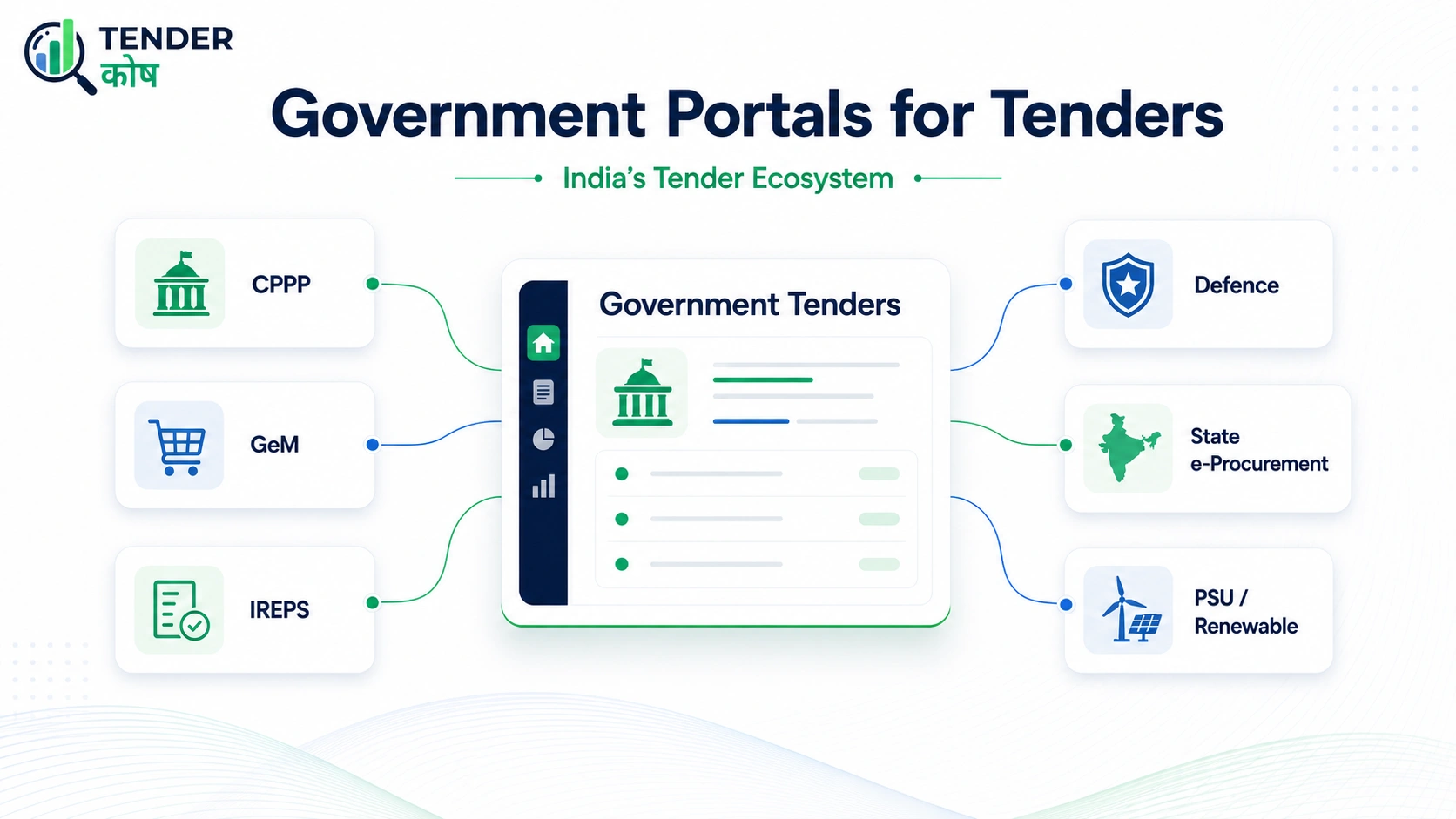
Watching ten-plus portals manually, every working day, is a full-time job no one does perfectly — which is exactly why tenders and corrigenda get missed. An aggregator solves the discovery problem without changing where you bid.
The reliable approach is to let a tender aggregator pull listings and amendments from many portals into a single dashboard, filter them by your keywords, sector, and geography, and alert you when something relevant appears or changes. You still download and submit each bid on the official portal where it’s published — the aggregator handles discovery and tracking, not submission. This is especially valuable for catching corrigenda, which portals rarely push proactively; a single missed amendment can undo weeks of preparation, as covered in our guide on what a corrigendum in a tender is.
That combination — broad discovery across every relevant portal, plus real-time corrigendum alerts — is what TenderKosh is built around, so your team spends its time on the tenders it can win instead of hunting for them.
No. There is no single national board where every Indian government tender is published. Central ministries and PSUs use the Central Public Procurement Portal (CPPP) and GeM, Railways uses IREPS, Defence has its own e-procurement system, and each state runs its own e-procurement portal. Bidders active across sectors and states have to watch several portals.
GeM (Government e-Marketplace) is the national marketplace for procuring common-use goods and services online, with catalogue buying, L1 bidding, and reverse auctions. CPPP (Central Public Procurement Portal at eprocure.gov.in) is the central e-tendering platform where ministries, departments, and PSUs publish tenders, typically for works, high-value supplies, and services.
Indian Railways publishes its tenders on IREPS (Indian Railway Electronic Procurement System) at ireps.gov.in, covering goods, works, and services procurement across railway zones and production units.
Generally yes. Most portals require separate registration and a valid Class 3 Digital Signature Certificate to download documents and submit bids. You can discover tenders across portals through an aggregator, but bid submission still happens on the official portal where the tender is published.
Because tenders and corrigenda are spread across many portals with inconsistent notifications, most active bidders use a tender aggregator that pulls listings and amendments from multiple portals into a single dashboard with keyword filters and alerts, then submit their bids on the official portal where each tender is published.
India’s government tenders will always be spread across many portals — that’s a feature of how public procurement is organised, not a problem you can register your way out of. The winning approach is to know the handful of government portals for tenders that matter for your sector, register where you’ll actually bid, and use an aggregator to watch the whole field so nothing slips past you.
See the full field early, catch every corrigendum, and you turn a scattered, easy-to-miss landscape into a steady pipeline of opportunities you’re positioned to win.
Note: Portal names, URLs, and coverage are current at the time of writing and may change; always confirm the official “.gov.in” address for each authority before registering or bidding. Central government tenders are published on the Central Public Procurement Portal, eprocure.gov.in, and the Government e-Marketplace, gem.gov.in.
This article is general information, not advice. It has been compiled from publicly available sources — government releases and notifications, official portals, published tender documents and trade reporting — and reflects our understanding at the time of writing. It is not legal, financial, tax or professional advice, and it does not create any advisory relationship.
Public procurement changes constantly. Tender terms, eligibility criteria, thresholds, fees, deadlines, scheme conditions and government policy are revised frequently, often through corrigenda issued mid-window and sometimes without wide notice. Figures and rules that were accurate when published may already have changed by the time you read this.
Always verify against the primary source before you act or bid. The tender document, the issuing authority's official portal and the relevant government notification are the authoritative sources. Where anything in this article differs from them, the official source prevails. Do not rely on this page — or on any third-party summary — as the basis for a bid, an investment or a compliance decision.
TenderKosh is a private tender-intelligence platform. We are not a government body, and we are not affiliated with, endorsed by or acting on behalf of any government department, ministry, PSU or procurement portal. Names, marks and portals referenced belong to their respective owners and are used for identification only. External links are provided for convenience; we do not control and are not responsible for third-party content.
While we take reasonable care, we make no warranty as to the accuracy, completeness or currency of this content, and accept no liability for any loss or damage arising from reliance on it.Spotted something wrong or out of date? Please tell us at support@tenderkosh.com — we correct errors promptly.See our full Disclaimer.
Discover relevant tenders, monitor corrigenda, compare opportunities, and move from document reading to structured action.