
TenderKosh for EPC teams
Turn tender reading into faster bidding decisions.
Discover relevant tenders, monitor corrigenda, compare opportunities, and move from document reading to structured action.
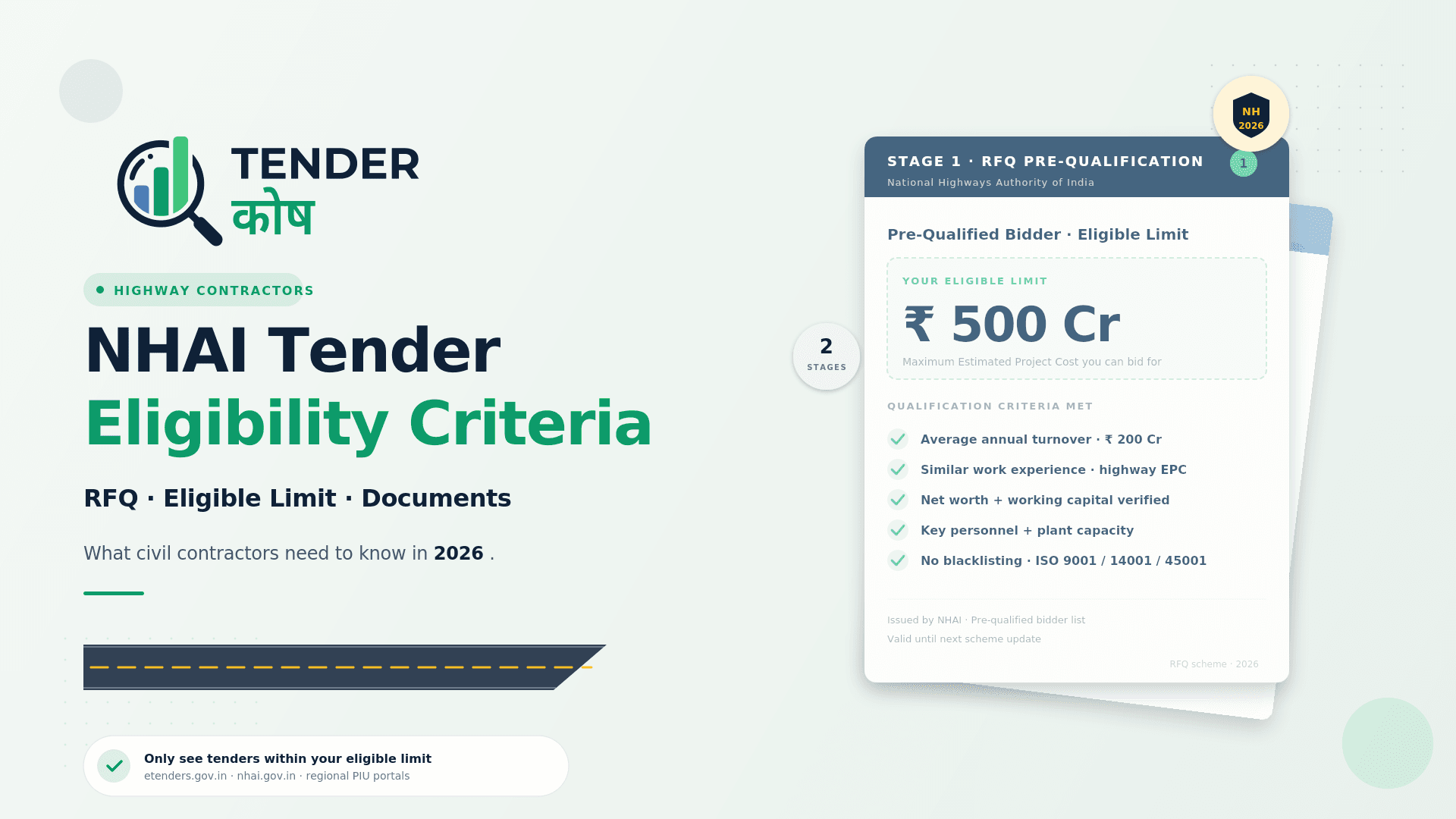
NHAI tender eligibility criteria are the technical, financial and experience requirements a bidder must satisfy before an NHAI tender can be considered for evaluation. Depending on the project, these may include similar-work experience, minimum turnover, net worth, technical capability, key personnel, equipment, statutory registrations and other tender-specific qualifications.
The exact requirements always depend on the individual NHAI tender document — thresholds are set as a proportion of the estimated project cost and vary by package, so there is no single universal figure to memorise.
This guide explains how NHAI eligibility criteria are actually structured, gives you a quick eligibility checklist, walks through why experienced contractors still get rejected, and shows a step-by-step way to check your eligibility before you invest time preparing a bid. The goal is to teach you how to read NHAI eligibility criteria for any tender, rather than to pretend there is one fixed threshold that applies everywhere.
Key Takeaways
On this page
NHAI tender eligibility criteria are the set of qualifications a bidder must satisfy before their bid is even considered for technical and financial evaluation. They exist to make sure that whoever wins can actually deliver a highway project of the size, complexity, and risk involved — which is why they scale with the project rather than staying fixed.
In practice, these criteria fall into a few consistent buckets: experience (completed “similar work”), financial strength (turnover and net worth), technical capacity (equipment and methodology), key personnel, and statutory documents. What changes from tender to tender is the threshold attached to each bucket — almost always expressed as a percentage of the estimated project cost. A ₹300 crore package and a ₹3,000 crore package can share the same structure of criteria while demanding very different numbers.
This is the single most important thing to understand about NHAI eligibility: there is no universal “you need X crore turnover” answer. The RFQ or RFP document for each specific tender is the only authoritative source for its numbers, and reading that document carefully is the real skill. The sections below explain how each bucket typically works so you can decode any NHAI tender’s eligibility section quickly.
Use this checklist as a first-pass filter on any NHAI tender before you commit time to a full bid. It won’t give you the numbers — those live in the tender document — but it tells you exactly what to go and confirm.
| Requirement | What to Check |
|---|---|
| Similar work experience | Does your completed work match NHAI’s definition of “similar work” for this tender? |
| Annual turnover | Does your average annual turnover meet the stated financial threshold? |
| Net worth | Do you satisfy the minimum net-worth requirement? |
| Technical capacity | Do you have the required technical capability and equipment? |
| Key personnel | Do your proposed personnel meet the experience requirements? |
| Financial capacity | Can you provide the required financial documents / solvency evidence? |
| Statutory documents | GST, PAN, registrations, and other tender-specific documents in order? |
| Bid security / EMD | Have you checked the exact EMD / bid-security requirement for this tender? |
Don’t assume fixed thresholds. The checklist tells you what to verify, not the numbers to expect. NHAI turnover, net-worth, and similar-work figures vary by tender and package — always take the actual values from the specific RFQ or RFP.
The “similar work” clause is where more otherwise-qualified contractors get filtered out than anywhere else, because it’s defined narrowly and specifically in each tender. A project that looks similar in rupee value can still fail if it doesn’t match the type and components the tender demands.
NHAI’s EPC qualification framework was tightened under Policy Circular No. 11.70/2025 (dated 8 August 2025), which aligned EPC norms more closely with HAM and BOT models. Among other changes, it clarified that a single similar completed work must cost not less than 35% of the estimated project cost to qualify on that basis, and it emphasised demonstrated experience across the major project components rather than a single headline value. The practical takeaway for bidders is that “similar” now leans harder on what you built, not just how much it was worth.
Because the definition is tender-specific, the only safe approach is to read the exact “similar work” wording in the RFQ, then check your completed-work certificates against it line by line — value, scope, components, and completion status all included. If you’re weighing why two comparable-looking tenders set experience differently, our guide on why similar tenders carry different eligibility criteria explains the factors at work.
Financial eligibility in NHAI tenders is built around average annual turnover and net worth, both benchmarked against the estimated project cost. These figures screen out bidders who may be technically capable but financially too small to carry a project’s cash-flow and risk load.
Turnover is typically assessed over the last few financial years and must meet a stated proportion of the project cost; net worth is a separate test of financial stability, usually requiring a positive and sufficient figure as at a recent date. For large EPC and HAM tenders, NHAI’s RFQ also applies a bid-capacity or eligible-limit methodology that combines your financial and technical capacity — so higher turnover, higher net worth, and larger comparable projects together raise the ceiling on the project size you can bid for.
The documentation matters as much as the numbers. Audited financial statements, a chartered accountant’s certificate, and solvency evidence in the exact format the tender specifies are what actually prove your financial eligibility. A strong balance sheet presented in the wrong format, or turnover calculated on a basis the tender doesn’t accept, can still fail evaluation. When you reach the financial-bid stage, our explainer on the difference between the technical and financial bid is worth a read to keep the two envelopes clean.
Beyond money and past projects, NHAI tenders test whether you have the machinery, methodology, and people to execute the specific works. This is where technically demanding packages add requirements that a simple works tender never would.
Depending on the project, you may need to demonstrate ownership or assured availability of specific equipment, a construction methodology that meets the tender’s technical annexures, and named key personnel — project manager, highway engineer, quality and safety leads — each meeting minimum qualification and experience conditions. For specialised structures like major bridges, tunnels, or particular pavement types, the personnel and equipment conditions get correspondingly more specific.
As with everything else, these are defined per tender. The right move is to extract the technical-capacity annexure into your compliance checklist and confirm you can evidence each item — with CVs, equipment ownership or lease proof, and certifications — before you decide to bid.
Track the live NHAI tender feed with real-time corrigendum alerts, eligible-limit filters, and document-deadline tracking — so you never prepare a bid you’re disqualified to win.
How your eligibility is assessed depends on the procurement route — and NHAI uses two broad ones. Knowing which applies tells you when and how your qualification is actually judged.
For large EPC and HAM tenders, qualification is typically handled through a separate RFQ (Request for Qualification) stage, and applicants generally need to be on the pre-qualified list before the bid due date. This is where the bid-capacity methodology and similar-work tests do their heaviest work. Some RFQs restrict or disallow JV or consortium applications — OPRMC works are a common example — while others permit JVs subject to lead-member experience and minimum-stake conditions.
Smaller, single-stage tenders — routine maintenance, plantation, wayside amenities — often don’t require separate RFQ pre-qualification; eligibility is assessed within the single bid itself. The practical point is to identify the route early, because it changes your timeline: an RFQ-based EPC tender demands you clear qualification well before you can even submit a priced bid.
Most NHAI rejections aren’t about a contractor being incapable — they’re about an eligibility mismatch that a careful pre-bid review would have caught. These are the recurring reasons capable bidders still fail.
The thread running through almost all of these is documentation discipline and vigilance, not capability. The last two are worth special attention: NHAI eligibility can move mid-tender, so always check the latest corrigendum before finalising an NHAI bid rather than trusting the version of the criteria you first downloaded.
A short, disciplined check up front saves weeks of wasted preparation on a tender you were never eligible to win. Run this sequence on every NHAI tender before you commit.
This process turns NHAI eligibility from a source of nasty surprises into a quick go/no-go decision you can make with confidence on any tender.
Go deeper on the topics that decide an NHAI bid:
NHAI tender eligibility criteria are the technical, financial and experience requirements a bidder must satisfy before an NHAI tender can be considered for evaluation. Depending on the project, these may include similar-work experience, minimum turnover, net worth, technical capability, key personnel, equipment, statutory registrations and other tender-specific qualifications. The exact requirements always depend on the individual NHAI tender document.
Similar work is the tender’s own definition of comparable past experience, usually completed highway or road works of a defined value and type. NHAI’s EPC qualification framework (Policy Circular 11.70/2025) requires demonstrated experience across the major project components, so a project that looks similar in value may still not count if it doesn’t cover the components the tender specifies.
No. There is no single universal figure. Turnover, net worth and similar-work thresholds are set as a proportion of the estimated project cost and vary by tender and package. Always read the specific RFQ or RFP for the exact numbers rather than relying on a general rule.
For large EPC and HAM tenders, qualification is typically assessed through an RFQ stage, and applicants generally need to be on the pre-qualified list before the bid due date. Smaller single-stage works such as maintenance, plantation and amenities often do not require a separate RFQ pre-qualification. Always confirm the route in the specific tender document.
Most rejections come from eligibility mismatches rather than lack of ability: similar work not matching the exact definition, turnover calculated on the wrong basis, an experience certificate missing required details, documents in the wrong format, or a corrigendum that changed a requirement after the bidder prepared documents. Checking the latest corrigendum before submission avoids a large share of these.
NHAI tender eligibility criteria aren’t a fixed hurdle you can memorise once — they’re a tender-specific test you have to read carefully every single time. The contractors who win consistently aren’t the ones with a secret threshold; they’re the ones with a system for reading eligibility, checking their documents against it, and catching every corrigendum before it costs them a bid.
Get the eligibility read right, keep your documentation disciplined, and never submit against out-of-date criteria — and you stop losing bids you were fully capable of winning.
Reference: NHAI qualification requirements are set out in each tender’s RFQ / RFP under the Standard Documents for EPC, HAM, and BOT projects, as revised by NHAI Policy Circular No. 11.70/2025 (dated 8 August 2025). Always treat the specific tender document as the authoritative source for thresholds and definitions. Official tenders are published on the Central Public Procurement Portal, eprocure.gov.in.
This article is general information, not advice. It has been compiled from publicly available sources — government releases and notifications, official portals, published tender documents and trade reporting — and reflects our understanding at the time of writing. It is not legal, financial, tax or professional advice, and it does not create any advisory relationship.
Public procurement changes constantly. Tender terms, eligibility criteria, thresholds, fees, deadlines, scheme conditions and government policy are revised frequently, often through corrigenda issued mid-window and sometimes without wide notice. Figures and rules that were accurate when published may already have changed by the time you read this.
Always verify against the primary source before you act or bid. The tender document, the issuing authority's official portal and the relevant government notification are the authoritative sources. Where anything in this article differs from them, the official source prevails. Do not rely on this page — or on any third-party summary — as the basis for a bid, an investment or a compliance decision.
TenderKosh is a private tender-intelligence platform. We are not a government body, and we are not affiliated with, endorsed by or acting on behalf of any government department, ministry, PSU or procurement portal. Names, marks and portals referenced belong to their respective owners and are used for identification only. External links are provided for convenience; we do not control and are not responsible for third-party content.
While we take reasonable care, we make no warranty as to the accuracy, completeness or currency of this content, and accept no liability for any loss or damage arising from reliance on it.Spotted something wrong or out of date? Please tell us at support@tenderkosh.com — we correct errors promptly.See our full Disclaimer.
Discover relevant tenders, monitor corrigenda, compare opportunities, and move from document reading to structured action.