
TenderKosh for EPC teams
Turn tender reading into faster bidding decisions.
Discover relevant tenders, monitor corrigenda, compare opportunities, and move from document reading to structured action.
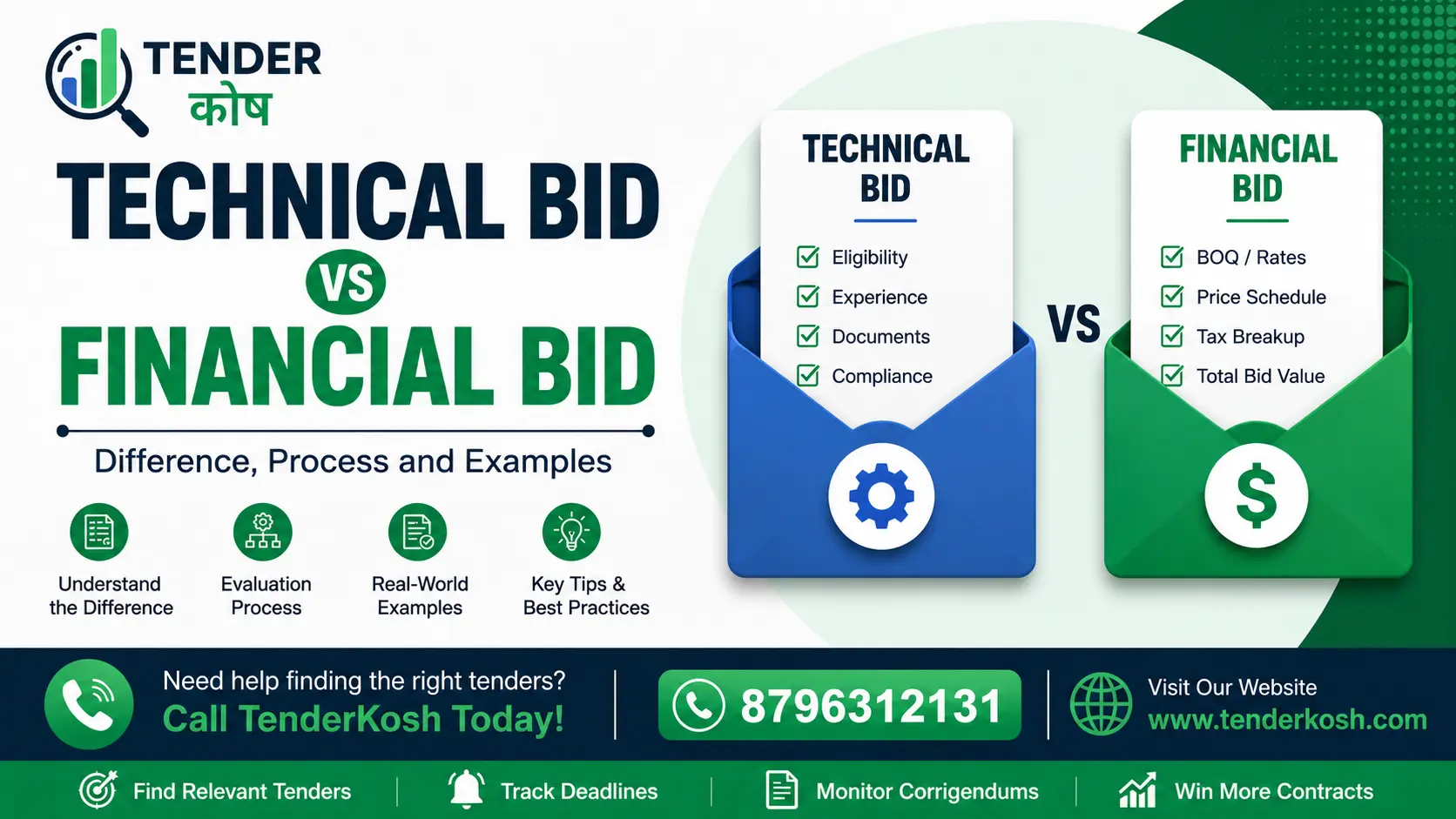
Confused about what goes into a Technical Bid and what belongs in a Financial Bid? One wrong document, misplaced price, or missed eligibility requirement can make an otherwise competitive tender bid non-responsive.In a typical two-bid government tender, the Technical Bid proves your eligibility, experience and ability to execute the work, while the Financial Bid contains your commercial offer and pricing. The technical submission is evaluated first, and only bidders who qualify technically move to financial evaluation.
The two-bid system — also called the two-envelope or two-cover system — is widely used for complex works, services, EPC projects and other government procurements where technical capability needs to be evaluated separately from price. The exact bid structure depends on the individual tender document and procurement method. Understanding how each bid works, what to include, and where bidders commonly go wrong is essential for any business competing in government procurement.
The Technical Bid answers “Can you execute the tender?” The Financial Bid answers “At what price?” The technical submission is evaluated first; only technically qualified bidders reach financial evaluation.
| Technical Bid | Financial Bid | |
|---|---|---|
| Purpose | Prove eligibility & capability | Quote the price |
| Price included? | Generally no | Yes |
| Evaluated | First | After technical evaluation |
| Typical documents | Experience, turnover, certificates, EMD | BOQ / price schedule |
| Result | Qualified / not qualified, or technical score | Financial ranking |
Key Takeaways
On this page
In a two-bid tender, the Technical Bid is the technical/eligibility submission, while the Financial Bid is the separate commercial submission. The portal may label these as Cover 1 and Cover 2, but the exact structure depends on the tender. It contains all non-price information that proves a bidder’s eligibility, capability, and compliance with the tender’s technical and qualification requirements. As a general rule, no pricing — not even indicative costs — should appear in the Technical Bid, though you should always follow the specific tender’s instructions.
The tendering authority evaluates Technical Bids to shortlist qualified bidders. Bidders who do not meet the applicable qualifying criteria are not taken forward to financial evaluation.
The following are common examples; the actual document checklist must be taken from the tender’s NIT, RFP/RFQ, eligibility criteria and submission instructions:
Critical rule: Including price information in a technical submission can make the bid non-responsive or lead to disqualification where the tender prohibits disclosure of pricing in the technical envelope. Keep technical and financial information strictly separate, and always follow the tender’s specific instructions.
A Financial Bid is the second envelope submitted in a two-bid tender. It primarily contains the bidder’s commercial offer, such as the quoted rates, BOQ (Bill of Quantities), price schedule, taxes and other financial information requested in the tender. Financial Bids are opened only after Technical Bid evaluation is complete and technically qualified bidders are declared.
In a price-based evaluation, technically qualified bidders may be ranked based on their evaluated financial offer, with the lowest evaluated responsive bidder generally designated L1. Contract award remains subject to the tender conditions and approval process.
Financial Bids typically contain:
Important: Never modify the BOQ structure provided by the tendering authority. Bidders must fill only the rate and amount columns. Changing item descriptions, units, or quantities — even to correct an apparent error — can result in disqualification. Raise a pre-bid query if you find an error in the BOQ before the deadline.
The table below summarises the core differences between a Technical Bid and a Financial Bid across the parameters most relevant to government tender submission in India.
| Parameter | Technical Bid | Financial Bid |
|---|---|---|
| Purpose | Proves eligibility, capability, and technical compliance | Provides the price at which the bidder will execute the work or supply |
| Evaluated by | Technical Evaluation Committee (TEC) | Finance or Procurement Committee — after TEC clearance only |
| Opened when | On the technical bid opening date specified in the tender | Only after technical evaluation is complete and results are declared |
| Contains | Eligibility documents, experience proof, certifications, EMD | BOQ, rate schedule, total bid price, GST breakup |
| Pricing shown? | Generally no — price references can make the bid non-responsive | Yes — this is the cover where prices are quoted |
| Outcome | TQ / NTQ, or a technical score in scored procurements | L1, L2, L3 ranking by lowest evaluated price |
| If not qualified | Result declared; documents retained by authority | Financial Bid not considered for financial evaluation |
| EMD submitted here? | Generally yes, where required | No |
| Portal label | Cover 1 / Envelope 1 / Technical Cover | Cover 2 / Envelope 2 / Financial Cover |
| MSME benefit declared here? | Udyam certificate and exemption declaration with technical/eligibility submission | Price preference matching declared here where applicable |
The simplest rule: anything that proves who you are and what you can do goes in the Technical Bid; anything that states a price goes in the Financial Bid. The table below maps the most common documents.
| Document | Technical Bid | Financial Bid |
|---|---|---|
| GST certificate | ✓ | ✗ |
| PAN | ✓ | ✗ |
| Work order | ✓ | ✗ |
| Completion certificate | ✓ | ✗ |
| Turnover certificate | ✓ | ✗ |
| Technical compliance statement | ✓ | ✗ |
| EMD / bid security | As specified | Usually not |
| BOQ rates | ✗ | ✓ |
| Price schedule | ✗ | ✓ |
| Tax / price breakup | ✗ | ✓ where requested |
| Commercial offer | ✗ | ✓ |
The tender document always takes precedence if it specifies a different submission arrangement. Use this table as a default, then confirm against the specific tender’s cover instructions before uploading.
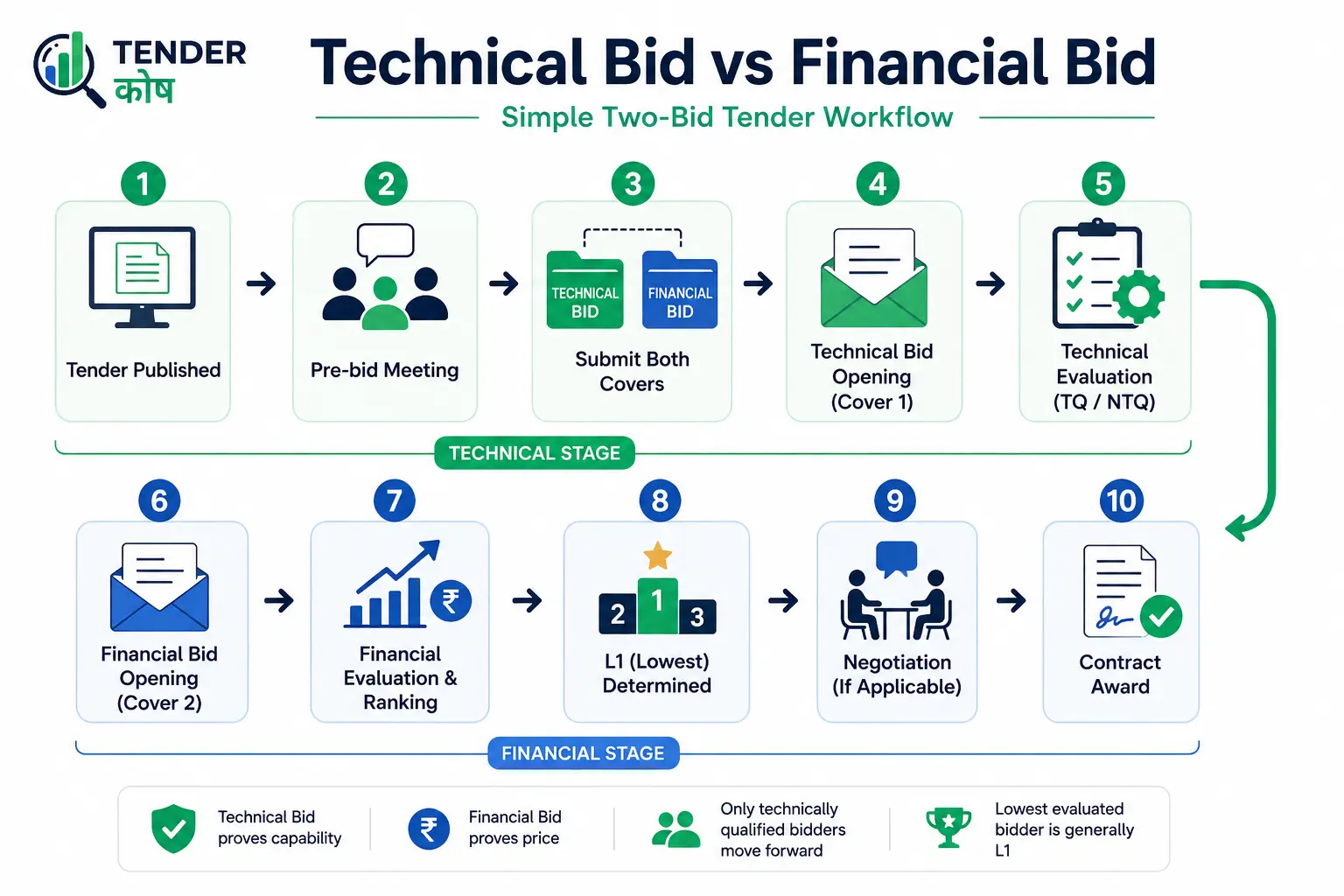
The two-bid system follows a sequential process. Understanding each stage helps bidders prepare the right documents at the right time and avoid errors that cause disqualification or missed deadlines.
| Stage | Action | What Happens |
|---|---|---|
| Stage 1 | Tender published on e-portal | Tender document released on GeM, CPPP, state portal, or PSU portal with eligibility criteria, technical specifications, BOQ format, and separate submission instructions for each cover. |
| Stage 2 | Pre-bid meeting and corrigendum period | Bidders may attend the pre-bid meeting, raise queries on qualifying criteria, specifications, or BOQ, and receive official clarifications. Corrigenda are issued on the portal — all must be tracked before submission. |
| Stage 3 | Bidders prepare and upload both covers | Technical Bid documents compiled and Financial Bid BOQ priced. Both uploaded to the portal as separate covers before the submission deadline. |
| Stage 4 | Technical Bid opening (Cover 1 opened) | The tendering authority opens Technical Bids on the declared date. Bidders or their authorised representatives can attend. No pricing information is visible at this stage. |
| Stage 5 | Technical Evaluation Committee (TEC) reviews bids | Each bidder’s documents are checked against qualifying criteria — turnover, experience, certifications, EMD validity, and technical compliance. TQ or NTQ status (or a technical score) is assigned. |
| Stage 6 | Technical evaluation results declared | List of technically qualified bidders published on the portal. Bidders who do not qualify are notified, and their Financial Bids are not taken forward for financial evaluation. |
| Stage 7 | Financial Bid opening (Cover 2 opened) | Only the Financial Bids of qualified bidders are opened. Prices are read out or published. Bidders are ranked L1 (lowest) to Ln (highest evaluated price). |
| Stage 8 | Negotiation and contract award | The L1 bidder may be invited for negotiations in some tenders. Contract is awarded after approval from the competent authority. Performance security is submitted before work commencement. |
Track live two-bid tenders across GeM, CPPP, PSUs, solar, EPC, civil, electrical, and railway sectors — so your team never misses a submission or opening date.
The two-bid system is used across virtually every sector of Indian government procurement. The examples below are illustrative of what typically goes into each bid cover for different tender types — not specific live tenders.
| Tender Type | Tendering Authority | Technical Bid: What Is Required | Financial Bid: What Is Quoted |
|---|---|---|---|
| Solar EPC Project | SECI / NTPC / State DISCOM | Prior EPC experience in MWp, net worth, turnover proof, technical team credentials, equipment make approval list | BOQ with module supply, civil works, mounting structure, inverter, BOS, and O&M rates per MWp |
| Road Construction | NHAI / State PWD / MoRTH | Similar road project completion certificates, key personnel CVs, equipment ownership proof, ISO certification | Item-rate BOQ for earthwork, sub-base, base course, bituminous layers, structures, and road furniture |
| IT Services | NIC / MeitY / State IT Dept | Technical approach document, team profiles with CVs, solution architecture, data security compliance, past project references | Manpower rates per role per month, or lump sum price with milestone-linked payment schedule |
| Medical Equipment Supply | CMSS / State Health Dept / AIIMS | Product technical datasheet, CDSCO regulatory approval, ISO 13485, after-sales service network proof, warranty terms | Unit price per equipment, installation charges, AMC rates per year |
| Consultancy / PMC | World Bank / ADB-funded projects | Firm profile, key expert CVs, methodology, work plan, experience in similar assignments scored against an evaluation matrix | Personnel costs per person-month, reimbursable expenses, total contract value |
| GeM Goods Supply | Central / State Govt GeM Buyers | OEM authorisation letter for resellers, product compliance documents, GeM Vendor Assessment certificate, Udyam certificate if claiming MSME preference | Unit rate per item as per GeM price schedule or bid format |
Technical Bid evaluation is based on pre-defined qualifying criteria published in the tender document. Some qualification criteria are pass/fail, while other procurements may use technical scoring or an evaluation matrix — the applicable evaluation method is specified in the tender document. The most common parameters used in Indian government tenders are:
Minimum annual turnover in specified financial years, positive net worth, and working capital or bank credit facility proof. Verified through CA-certified audited financial statements.
Completion of projects of a specified type, value, and scale within a defined look-back period — typically 5 to 7 years. Evidenced by work orders and client-issued completion certificates as a pair.
ISO, BIS, NABL, CDSCO, or sector-specific approvals. GeM Vendor Assessment for product sellers. Udyam Registration for MSME preference claims.
Important: Bidders should evaluate the latest version of the qualifying criteria and all issued corrigenda. Eligibility or technical requirements may be clarified or amended through an officially issued corrigendum before the applicable deadline. If a mandatory criterion is not met, a bid can be disqualified regardless of how competitive its price is — so read every clause before deciding to bid.
Not all government tenders use the two-bid system. Single-cover or single-stage procurement methods may be used for standard goods, lower-value procurement, and other procurements where separate technical and financial evaluation is not required. GeM procurement can follow different buying modes, so bidders should follow the specific bid structure shown on the GeM listing.
| Parameter | Single-Bid (One Cover) | Two-Bid (Two Cover) |
|---|---|---|
| Used for | Standard goods, lower-value procurement, rate contracts, and other procurements not needing separate evaluation | Complex works, EPC contracts, high-value services, infrastructure projects |
| Submission structure | Single envelope with eligibility and price together | Separate envelopes or covers for technical and financial bids |
| Evaluation sequence | Simultaneous review of eligibility and price | Sequential: technical first, financial only after qualification is declared |
| Price visibility | Price visible on opening — less strategic flexibility | Price protected until technical clearance — better for complex pricing |
| Common portals | GeM (many buying modes), small-value CPPP tenders | CPPP, state e-tender portals, Railways, defence, PSU infrastructure projects |
| MSME benefit claim | Claimed in the single cover along with price | Eligibility documents and exemption claims with technical submission; price preference matching in the financial cover |
Most bid disqualifications in two-bid tenders are caused by avoidable document and process errors. The following are the most frequent — along with the correct approach for each.
| Mistake | Which Cover Affected | Impact | How to Avoid |
|---|---|---|---|
| Including price in the Technical Bid where prohibited | Technical Bid | Bid can be non-responsive or disqualified | Double-check every document in Cover 1. Remove any rate, cost estimate, or financial figure not explicitly required in the technical cover instructions. |
| Missing or expired EMD | Technical Bid | Non-responsive bid — not evaluated further | Submit EMD as per the exact format, amount, and validity specified. Verify MSME EMD exemption eligibility before skipping. |
| Wrong financial years for turnover documents | Technical Bid | Turnover criterion not met; disqualification | Read the qualifying criteria carefully — tenders specify exact year combinations. Submit audited statements for the years required, not the most favourable years. |
| Completion certificates not issued by the client | Technical Bid | Experience criterion rejected | Submit certificates issued and signed by the actual client. Pair each work order with its corresponding completion certificate from the same organisation. |
| Documents uploaded in the wrong cover | Both | Documents appear in wrong envelope — bid may be NTQ or price exposed prematurely | Map each document to the correct cover using the tender’s document checklist before upload. Review the portal cover structure carefully before final submission. |
| Ignoring corrigenda after submission | Both | Bid lapses, deadline missed, or eligibility conditions changed without bidder awareness | Monitor the portal for corrigenda throughout the bid period. Corrigenda can change qualifying criteria, EMD amounts, BOQ quantities, or submission deadlines. |
| Leaving BOQ items blank in Financial Bid | Financial Bid | Disqualification or severe financial loss if awarded at a zero rate | Every BOQ item must have a rate. Cross-check that all rows are filled before submitting Cover 2. |
| Not declaring MSME price preference eligibility | Financial Bid | L1 matching benefit not applied even if eligible | Declare MSME price preference eligibility in the correct portal field. Upload Udyam certificate with the technical submission and select the preference option where available. |
Use the following checklist to verify your Technical Bid is complete before uploading to the e-tender portal. Each item must be confirmed against the specific tender before the submission deadline.
Certificate of incorporation, GST registration, PAN card, Udyam Registration Certificate, and any sector-specific licences or approvals required by the tender.
Audited balance sheets and P&L statements for the required years. CA-certified turnover certificate if separately required. Solvency certificate or bank credit letter where specified.
Work orders and client-issued completion certificates for similar projects. Each certificate must state project value, completion date, and nature of work — matching the qualifying parameters.
Bank guarantee, demand draft, or bid security declaration for exempt MSEs. Verify amount, validity date, and beneficiary name match the tender exactly. See EMD in Government Tenders for full guidance.
Filled technical compliance statement or deviation sheet. Product datasheets, drawings, or specifications where required. Confirm no pricing appears in any of these documents before upload.
ISO, BIS, GeM Vendor Assessment certificate, NABL, CDSCO, or any sector-specific quality certification listed as mandatory or preferred in the tender document.
A Technical Bid contains eligibility and capability documents — experience, turnover, certifications, and EMD — generally with no pricing. A Financial Bid contains the commercial offer — BOQ rates, total bid value, and tax breakup. In a two-bid tender, Technical Bids are evaluated first, and the Financial Bids of only technically qualified bidders are opened.
Common examples include company registration, GST and PAN, audited financials and turnover proof, similar-work experience (work orders paired with completion certificates), technical compliance statements, certifications, and EMD or bid security. The actual checklist must be taken from the specific tender’s NIT, RFP/RFQ, eligibility criteria, and submission instructions.
The Financial Bid primarily contains the bidder’s commercial offer — the filled BOQ or price schedule, unit rates, taxes, and total bid value — along with any other financial information the tender format requests.
Including price information in a technical submission can make the bid non-responsive or lead to disqualification where the tender prohibits disclosure of pricing in the technical envelope. Always follow the tender’s specific submission instructions.
TQ stands for Technically Qualified and NTQ for Not Technically Qualified. These are the outcomes of Technical Bid evaluation. TQ bidders proceed to Financial Bid opening; the financial bids of bidders who do not qualify technically are not considered for financial evaluation, in accordance with the tender’s procedure.
Eligible Micro and Small Enterprises can claim EMD exemption in many government tenders by providing a valid Udyam Registration Certificate with the technical or eligibility submission and selecting the exemption option on the portal. Not every tender allows EMD exemption, so the EMD clause must be checked in each specific tender document. See our full guide on MSME benefits in government tenders.
Official References:
The key difference is simple: the Technical Bid answers “Can you execute the tender?” while the Financial Bid answers “At what price will you execute it?” In a two-bid procurement, getting technically qualified is the first gate; submitting a compliant and competitive financial offer comes next.
Before submission, always check the latest tender document, corrigenda, eligibility criteria, technical specifications, and bid-submission instructions — requirements vary from one procurement to another. TenderKosh helps businesses discover and monitor relevant government tenders, deadlines, and corrigenda across multiple procurement portals.
This article is general information, not advice. It has been compiled from publicly available sources — government releases and notifications, official portals, published tender documents and trade reporting — and reflects our understanding at the time of writing. It is not legal, financial, tax or professional advice, and it does not create any advisory relationship.
Public procurement changes constantly. Tender terms, eligibility criteria, thresholds, fees, deadlines, scheme conditions and government policy are revised frequently, often through corrigenda issued mid-window and sometimes without wide notice. Figures and rules that were accurate when published may already have changed by the time you read this.
Always verify against the primary source before you act or bid. The tender document, the issuing authority's official portal and the relevant government notification are the authoritative sources. Where anything in this article differs from them, the official source prevails. Do not rely on this page — or on any third-party summary — as the basis for a bid, an investment or a compliance decision.
TenderKosh is a private tender-intelligence platform. We are not a government body, and we are not affiliated with, endorsed by or acting on behalf of any government department, ministry, PSU or procurement portal. Names, marks and portals referenced belong to their respective owners and are used for identification only. External links are provided for convenience; we do not control and are not responsible for third-party content.
While we take reasonable care, we make no warranty as to the accuracy, completeness or currency of this content, and accept no liability for any loss or damage arising from reliance on it.Spotted something wrong or out of date? Please tell us at support@tenderkosh.com — we correct errors promptly.See our full Disclaimer.
Discover relevant tenders, monitor corrigenda, compare opportunities, and move from document reading to structured action.