
TenderKosh for EPC teams
Turn tender reading into faster bidding decisions.
Discover relevant tenders, monitor corrigenda, compare opportunities, and move from document reading to structured action.
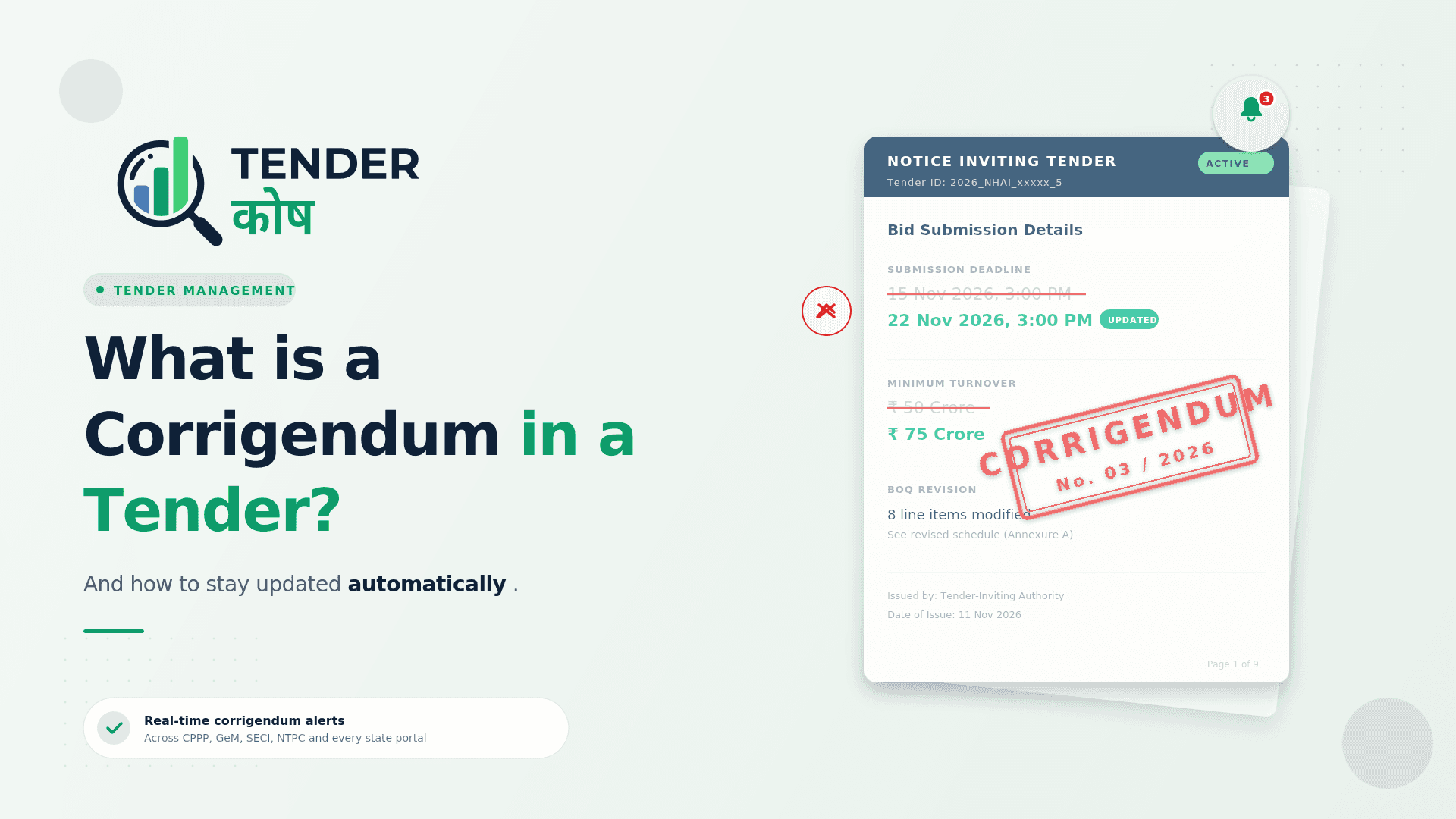
A corrigendum in a tender is an official correction or amendment issued by the tendering authority after a tender has been published. It can change the bid submission deadline, eligibility criteria, BoQ, EMD, technical specifications, scope of work, or other tender conditions.
In simple terms, a tender corrigendum tells bidders that something in the original tender has changed and the latest version must be followed. Missing one can lead to costly mistakes — from pricing the wrong BoQ to submitting a bid after a revised deadline or failing to meet updated eligibility requirements.
In this guide, you’ll learn what a corrigendum means, what it can change, how it differs from an addendum or amendment, how to check whether a tender has a corrigendum, why bidders miss them, and how to track tender updates more reliably.
Key Takeaways
On this page
A corrigendum is an official amendment issued by the tender-inviting authority that modifies one or more terms of a previously published tender. It can change deadlines, eligibility, scope, BoQ, EMD requirements, technical specifications, or any other clause of the original Notice Inviting Tender (NIT).
In simpler terms: it’s the government’s way of saying “we changed our minds, and your bid has to follow the new rules, not the old ones.”
Once a corrigendum is live, it’s published on the same portal as the original NIT and becomes part of the tender document. The tender then reads as the original as modified by the corrigendum, and the earlier version no longer governs.
In Indian government tendering these three words are often used interchangeably, and that’s mostly fine because the practical effect is identical. But there are subtle differences worth knowing.
| Term | What It Typically Means |
|---|---|
| Corrigendum | A correction or modification to the existing tender — the most common usage. |
| Addendum | An addition of new content to the tender (a new clause, new annexure, or a clarification document). |
| Amendment | A formal change to a specific clause, often used when contract terms are revised. |
For practical bidding, treat all three the same way: read it carefully, factor it into your bid, and check whether the deadline has changed.
A tender corrigendum almost always modifies one or more of the core bid conditions — the deadline, the eligibility bar, the pricing structure, or the technical requirements. Understanding which of these has changed is the whole point of reading it carefully, because each one affects your bid differently.
The most common change by far is a shift in the bid submission deadline, but a corrigendum can just as easily raise a turnover threshold, add or drop BoQ line items, or revise a technical specification. The full breakdown is below.
Every corrigendum modifies at least one of these, and a single tender can carry several at once.
| # | What Changes | Why It Matters |
|---|---|---|
| 1 | Bid submission deadline | By far the most common, usually as a date extension. |
| 2 | Pre-bid meeting date | Issued if the original date was unworkable or had to be rescheduled. |
| 3 | Eligibility criteria | Turnover, experience, certifications, or geographic restrictions. |
| 4 | Scope of work | Items added, removed, or specifications changed. |
| 5 | BoQ (Bill of Quantities) | Line items, quantities, or units modified. |
| 6 | EMD or tender fee | Amount, payment mode, or exemption clauses. |
| 7 | Technical specifications | Equipment specs, drawing revisions, performance parameters. |
A single tender can and often does have multiple corrigenda issued over its lifetime. It’s not unusual to see Corrigendum 1, 2, 3, 4, 5 stacked on a single bid. If you want to understand how much the eligibility criteria or the priced BoQ structure can move a bid’s outcome, those two clauses are usually where a corrigendum does the most damage if missed.
Before submitting a government tender bid, check the tender’s official portal page for any corrigendum, amendment, clarification, or deadline update. A short, repeatable process catches almost every change in time.
If a tender has multiple corrigenda, don’t assume the latest document replaces everything in the original tender. Check exactly which clauses, dates, or documents each corrigendum modifies — a later corrigendum may amend only one clause while leaving the rest of an earlier one intact.
Missed corrigenda are quietly one of the most expensive failure modes in Indian government bidding — and the reasons are operational, not a matter of carelessness.
This is why a single missed corrigendum can undo weeks of otherwise flawless bid preparation.
A few patterns show up repeatedly — and none of them involve a careless bidder.
None of these bidders were necessarily careless. They simply missed critical updates because tender portals and procurement systems may not provide consistent proactive notifications for every corrigendum.
If you want to track corrigenda manually, here’s the discipline it actually takes. For one or two tenders it’s doable; for a real pipeline it’s a full-time job nobody does perfectly.
For a serious bidding pipeline of 15–30 active tenders across 10+ portals, this level of manual vigilance simply isn’t sustainable — which is exactly where things fall through the cracks.
Automated corrigendum tracking removes the daily refresh-and-check routine entirely. Here’s what good automated tracking looks like — and what TenderKosh is built around.
This is exactly the workflow TenderKosh was built for — because the difference between winning and losing often isn’t bid quality. It’s whether you saw the update in time.
Follow live tenders and every corrigendum across SECI, NTPC, GeM, CPPP, and state portals in real time — with the change highlighted, so you see the update before your competitors do.
Now that you understand how corrigenda work, go deeper with these guides:
There is no formal limit. A complex tender can easily have 5–10 corrigenda over its bidding period, especially for large infrastructure or EPC projects with extended timelines and pre-bid clarifications.
You don’t need to “accept” it like a contract amendment. But your bid is generally governed by the latest applicable corrigendum-amended terms, whether you read it or not. A bid that does not comply with an applicable corrigendum can be treated as non-responsive, depending on the tender’s terms and the nature of the change.
Yes. Tender-inviting authorities frequently issue corrigenda cancelling, withdrawing, or rebidding tenders — sometimes after partial bid submission. The reasons vary: insufficient bidders, scope changes, audit objections, or policy shifts.
Most procurement guidelines suggest corrigenda affecting bid preparation should be issued well before the bid submission deadline — commonly around 7 to 15 days — with a corresponding deadline extension if the change is substantial. CVC-aligned guidance also discourages bringing a deadline forward. In practice, timing is widely inconsistent, especially for minor corrections.
Bids are generally evaluated according to the tender documents and applicable amendments or corrigenda issued by the tendering authority. If your bid is non-compliant with an applicable corrigendum — wrong eligibility, wrong BoQ structure, wrong technical specs — it can be treated as non-responsive, and you may forfeit the EMD depending on the tender’s terms and the nature of the change.
Open the original tender notice and note the Tender ID, then check the corrigendum or amendment section on the official tender page, compare the latest corrigendum against the original NIT, and confirm the revised deadline, eligibility, BoQ, EMD, and technical specifications before preparing your bid. If multiple corrigenda have been issued, check exactly which clauses each one modifies rather than assuming the latest replaces everything.
A corrigendum is one of the most under-watched documents in Indian government tendering. It can be the difference between a bid you win and a bid you lose — and the system doesn’t always make it easy to keep up with.
You can either build a manual tracking discipline that demands hours every day across every portal you watch, or you can let software do it. That’s the choice TenderKosh makes for you: every corrigendum, every portal, surfaced in real time, with the change clearly highlighted. You stop missing updates, and you start submitting bids that actually qualify.
Reference: Corrigenda in Indian public procurement are governed by the transparency and fair-competition principles of the General Financial Rules (GFR) 2017 and supplementary Central Vigilance Commission guidance, and must be published on the same portal as the original NIT (for central tenders, the Central Public Procurement Portal, eprocure.gov.in).
This article is general information, not advice. It has been compiled from publicly available sources — government releases and notifications, official portals, published tender documents and trade reporting — and reflects our understanding at the time of writing. It is not legal, financial, tax or professional advice, and it does not create any advisory relationship.
Public procurement changes constantly. Tender terms, eligibility criteria, thresholds, fees, deadlines, scheme conditions and government policy are revised frequently, often through corrigenda issued mid-window and sometimes without wide notice. Figures and rules that were accurate when published may already have changed by the time you read this.
Always verify against the primary source before you act or bid. The tender document, the issuing authority's official portal and the relevant government notification are the authoritative sources. Where anything in this article differs from them, the official source prevails. Do not rely on this page — or on any third-party summary — as the basis for a bid, an investment or a compliance decision.
TenderKosh is a private tender-intelligence platform. We are not a government body, and we are not affiliated with, endorsed by or acting on behalf of any government department, ministry, PSU or procurement portal. Names, marks and portals referenced belong to their respective owners and are used for identification only. External links are provided for convenience; we do not control and are not responsible for third-party content.
While we take reasonable care, we make no warranty as to the accuracy, completeness or currency of this content, and accept no liability for any loss or damage arising from reliance on it.Spotted something wrong or out of date? Please tell us at support@tenderkosh.com — we correct errors promptly.See our full Disclaimer.
Discover relevant tenders, monitor corrigenda, compare opportunities, and move from document reading to structured action.