TenderKosh for EPC teams
Turn tender reading into faster bidding decisions.
Discover relevant tenders, monitor corrigenda, compare opportunities, and move from document reading to structured action.
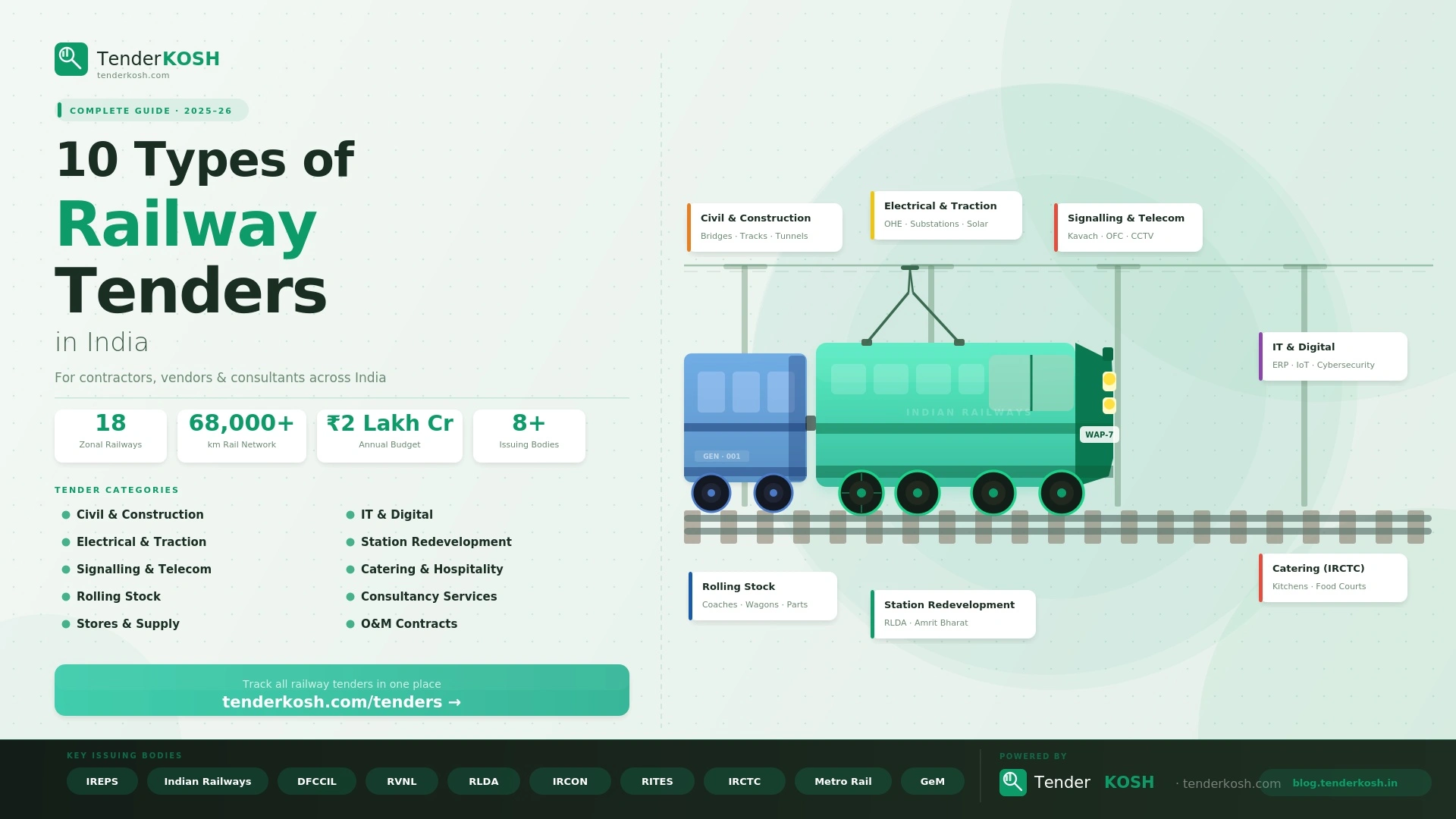
The types of railway tenders in India split along two independent axes: what is being bought, and how bidders are invited.
By subject: works, goods and stores, services, earning and leasing contracts, and scrap disposal. By method: open, limited, special limited, single, rate contract and global. A single tender always has one value on each axis — an open works tender, a limited goods tender — and confusing the two is why many new vendors chase tenders they were never eligible for.
Indian Railways is one of the largest single buyers in the country, spending in the region of ₹2.65 lakh crore a year across rolling stock, signalling, track, stations, electrification and services. Most of that flows through IREPS, the dedicated e-procurement system built by CRIS, which at any given time carries something in the order of 20,000 active tenders across the 18 zones and the production units.
That scale is an opportunity and a filtering problem in equal measure. Understanding the types of railway tenders is what turns 20,000 listings into the fifteen you can actually win. This guide covers both classification axes, where each type is published, what registrations and approvals each demands, and which routes make sense if you are starting out.
Key Takeaways
Railways runs its own procurement ecosystem rather than routing everything through the general central portals. IREPS at ireps.gov.in has handled railway procurement electronically since around 2009 and is purpose-built for railway terminology, contract types and approval workflows — which is precisely why bidders used to CPPP or GeM find it unfamiliar at first.
Procurement is decentralised across zonal railways, divisions, production units, workshops and stores depots, each buying for its own requirements. A division tenders station building work; a stores depot tenders track fittings; a workshop tenders maintenance services. There is no single national buying desk, which means the same category of work appears repeatedly across the network under different zone names — and monitoring one zone gives you a fraction of the picture.
The GeM overlap is growing. Railways advises vendors supplying common-use goods and services to register on GeM, and ordinary catalogue items are increasingly bought there rather than through a full IREPS tender. If you sell standard commercial products, your railway opportunity may look more like GeM registration than an IREPS bid.
This is the axis most vendors think of first, and it determines which registration and approval track you need. The five categories below cover essentially all railway procurement.
Construction, repair and maintenance: new lines and doubling, track laying and renewal, bridges and foot-over bridges, station buildings and platforms, electrification, workshops, staff quarters and drainage. Rates are commonly referenced against the railway schedule of rates, with the unified schedule in current use for railway works.
Who wins: registered civil and electrical contractors with plant, execution capacity and completed work of comparable value.
Material supply, from rolling stock and major components — coaches, wagons, locomotive parts, wheels, axles, bogies — through signalling and telecom equipment, track materials such as rails, sleepers, fittings and ballast, overhead electrification gear, and a long tail of consumable stores across depots and workshops.
Who wins: approved sources. Many technical and safety-critical items require item-specific vendor approval, which is a months-long process you complete before the tender, not during it.
Operating and support services: maintenance and annual maintenance contracts, housekeeping and sanitation, security, IT and software support, manpower supply, catering and on-board services, and specialist technical services.
Who wins: service firms with relevant experience and compliance credentials. Usually no product approval needed, which makes this the most accessible category for newcomers.
Commercial rights rather than purchases — parcel and luggage space leasing, parking, advertising and hoarding rights, stall and vending licences, and similar concessions. These run through the IREPS e-auction and leasing module rather than the standard tender process.
Who wins: commercial operators. Note the direction of money: you bid to pay Railways for the right, and your return depends on how well you monetise it.
Sale of released materials, condemned rolling stock, scrap metal and surplus stores through e-auction, with catalogues published in advance of scheduled auction dates.
Who wins: scrap traders and recyclers who can value a lot quickly, arrange lifting logistics and fund payment on award.
Design, study, technology development and consultancy requirements, often issued first as an Expression of Interest to test market capability before a formal tender follows.
Who wins: specialists. EOIs are worth responding to even speculatively — they often carry no bid security and let you influence the eventual specification.
Railway tenders are spread across 18 zones, production units, workshops and depots. Track them in one dashboard filtered by category, value and location — alongside GeM, CPPP and state portals — with corrigendum alerts so a late change never costs you a bid.
This axis decides whether you can participate at all, and it is the one new vendors most often overlook. A goods tender you are perfectly capable of fulfilling may be a limited tender issued only to already-approved sources — in which case no amount of preparation will get your bid evaluated.
| Method | Who Can Bid | Typically Used For |
|---|---|---|
| Open tender | Any bidder meeting the stated eligibility | Higher-value works, goods and services; the default competitive route |
| Limited tender | Only vendors on an approved or registered list | Items requiring pre-approved sources, or lower-value procurement |
| Special limited tender | A narrower selected set of vendors | Urgent or specialised requirements where the field is small |
| Single tender | One identified source | Proprietary items or where only one source is technically acceptable |
| Rate / blanket contract | Qualified bidders, awarded as a standing arrangement | Repeat-requirement items drawn down over a period without re-tendering |
| Global tender | International bidders, subject to applicable restrictions | High-value or technology items unavailable domestically |
| E-auction | Registered participants in the auction module | Leasing, earning contracts and scrap disposal |
Rate contracts deserve particular attention. A standing arrangement means Railways can order against your agreed rates repeatedly through the contract period without a fresh tender each time. That converts a single successful bid into a stream of orders — which is a fundamentally better business than winning one-off tenders, and worth targeting deliberately once you are an established supplier.
Knowing the types of railway tenders is only useful if you are looking in the right place for each one. Railway procurement is not consolidated on a single feed.
| Channel | What Appears There |
|---|---|
| IREPS — works module | Civil, electrical and infrastructure works from zones and divisions |
| IREPS — goods and services module | Stores procurement, material supply and service contracts |
| IREPS — e-auction / leasing | Earning contracts, leasing rights and scrap disposal catalogues |
| GeM | Common-use catalogue goods and standard services |
| CPPP and PSU portals | Railway PSU and project-company tenders (RITES, IRCON, RVNL, DFCCIL and similar) |
The practical consequence is that a vendor watching only ireps.gov.in misses the GeM and PSU streams entirely, while one watching only GeM misses the great majority of railway work. Our guide to the top government portals for tenders in India maps how these fit together.
Registration for railway tendering is category-specific, and getting the wrong one is a common and expensive false start.
Do not start with a goods tender for an approval-gated item. Vendor approval for technical and safety-critical items is a substantial process completed well ahead of any specific tender. Vendors regularly discover this after preparing a full bid for an item they were never an approved source for. Confirm the approval position for your exact item category before you invest effort — the framework has evolved over time, so check the current process rather than relying on older guidance.
The sensible sequence runs from lowest approval barrier to highest. Among the types of railway tenders, the accessible ones are not the ones with the biggest numbers attached.
| If You Are… | Start With | Then Progress To |
|---|---|---|
| A service firm | Services tenders and AMCs at division level | Multi-zone and higher-value service contracts |
| A civil contractor | Smaller works packages within one zone | Larger works across zones as credentials build |
| A standard product supplier | GeM catalogue listing for common-use items | IREPS stores tenders and rate contracts |
| A technical manufacturer | Vendor approval process, in parallel with services or GeM work | Limited and open goods tenders once approved |
| A commercial operator | Smaller leasing and parking e-auctions | Larger advertising and parcel space contracts |
Most railway tender failures are procedural, and they repeat across categories.
Railway tenders divide by subject matter into works tenders (civil construction, track, electrification, station buildings), goods and stores tenders (rolling stock components, track materials, signalling and telecom equipment, consumables), services tenders (maintenance, housekeeping, IT, catering, security), earning and leasing contracts awarded through e-auction, and scrap or disposal sales. They divide separately by bidding method into open, limited, special limited, single, rate contract and global tenders.
Most railway procurement is published on IREPS at ireps.gov.in, the dedicated Indian Railways e-procurement system built by CRIS. Common-use goods and services available as catalogue items are increasingly bought through GeM instead, and Railways advises vendors of such items to register there. Some railway PSU and project-company tenders appear on CPPP or their own portals.
An open tender is advertised publicly and any bidder meeting the eligibility criteria may participate. A limited tender is issued only to a restricted list of approved or registered vendors, typically for items where sources must be pre-approved or where value falls below a defined threshold. Special limited and single tenders narrow this further, down to a single source where technically justified.
For many safety-critical and technical items, yes. Vendor approval from RDSO or the relevant approving authority is item-specific and generally involves assessment of your manufacturing facility and product before you can be considered an approved source. Requirements vary by item category and the approval framework has evolved, so confirm the current process for your specific item before investing in it.
You need an IREPS bidder account and a valid Class 3 digital signature certificate registered with the system. Registration categories differ for works contractors, material vendors and service providers, and documents are verified by the relevant zonal railway office. Works contractors typically also register with the zonal railway, and goods suppliers may additionally need item-specific vendor approval.
Services tenders and lower-value works packages are usually the most accessible entry points, because they rarely require the item-specific product approvals that gate goods supply. Catalogue-style common-use supply through GeM is another low-friction start. Building a delivery record through these routes creates the credentials needed for larger works packages and approved-vendor status later.
It depends on the tender type and the zone’s conditions. Open tenders are generally accessible to any eligible bidder, while works tenders frequently expect registration with the concerned zonal railway. Read the eligibility clause carefully rather than assuming, and where a zone registration is required, treat obtaining it as a prerequisite rather than something to arrange after award.
The types of railway tenders in India are best understood as a grid rather than a list. Every tender has a subject — works, goods, services, leasing, scrap — and a method — open, limited, rate contract, auction. Reading both before you invest any effort tells you in thirty seconds whether the opportunity is real for your business.
For most newcomers, the honest route is services and smaller works packages first, GeM listing for standard products, and vendor approval pursued in parallel if you manufacture technical items. Build a delivery record, then move up to larger works and rate contracts — because a standing arrangement with Railways is worth considerably more than any single tender you will win along the way.
Note: Railway procurement procedures, portal modules, registration categories and vendor approval frameworks are revised from time to time, and thresholds for tender methods are set by policy that changes periodically. This guide describes the general structure current at the time of writing. Always confirm the applicable procedure, eligibility and approval requirements for your specific case on the official IREPS portal, ireps.gov.in, and in the individual tender document before bidding.
This article is general information, not advice. It has been compiled from publicly available sources — government releases and notifications, official portals, published tender documents and trade reporting — and reflects our understanding at the time of writing. It is not legal, financial, tax or professional advice, and it does not create any advisory relationship.
Public procurement changes constantly. Tender terms, eligibility criteria, thresholds, fees, deadlines, scheme conditions and government policy are revised frequently, often through corrigenda issued mid-window and sometimes without wide notice. Figures and rules that were accurate when published may already have changed by the time you read this.
Always verify against the primary source before you act or bid. The tender document, the issuing authority's official portal and the relevant government notification are the authoritative sources. Where anything in this article differs from them, the official source prevails. Do not rely on this page — or on any third-party summary — as the basis for a bid, an investment or a compliance decision.
TenderKosh is a private tender-intelligence platform. We are not a government body, and we are not affiliated with, endorsed by or acting on behalf of any government department, ministry, PSU or procurement portal. Names, marks and portals referenced belong to their respective owners and are used for identification only. External links are provided for convenience; we do not control and are not responsible for third-party content.
While we take reasonable care, we make no warranty as to the accuracy, completeness or currency of this content, and accept no liability for any loss or damage arising from reliance on it.Spotted something wrong or out of date? Please tell us at support@tenderkosh.com — we correct errors promptly.See our full Disclaimer.
Discover relevant tenders, monitor corrigenda, compare opportunities, and move from document reading to structured action.