TenderKosh for EPC teams
Turn tender reading into faster bidding decisions.
Discover relevant tenders, monitor corrigenda, compare opportunities, and move from document reading to structured action.
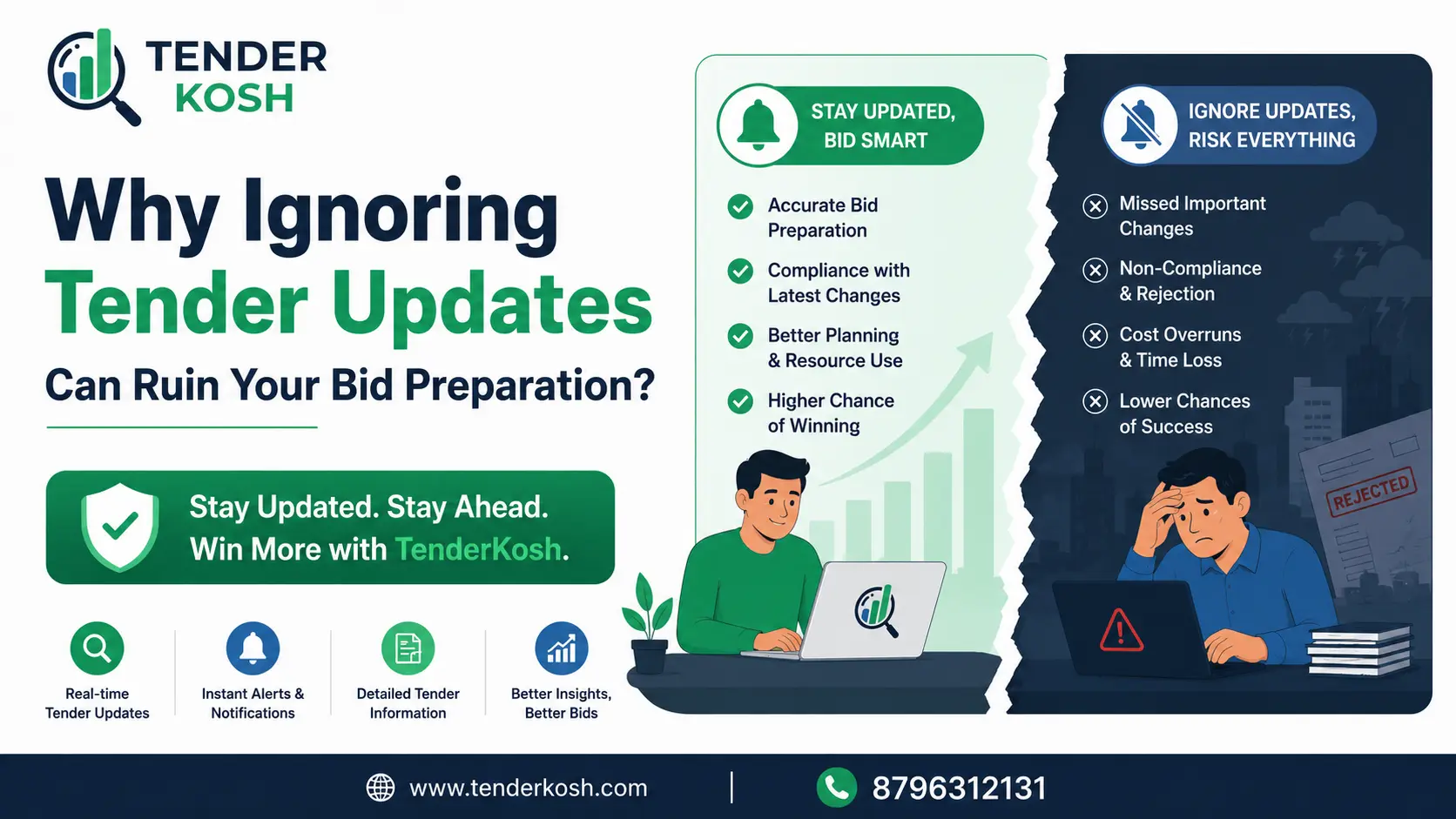
Tender Updates play a critical role in government bidding and procurement processes. Missing a corrigendum or addendum can lead to bid rejection, pricing errors, compliance issues, and lost business opportunities.
A corrigendum usually corrects or modifies existing tender information, while an addendum adds new information or clarifications to the tender document.
Yes. Corrigenda become part of the original tender document and are legally applicable to all bidders.
Yes. Missing an amendment can result in technical non-compliance, incorrect documentation, or pricing errors that may lead to disqualification.
Large government tenders commonly receive multiple corrigenda and clarifications before submission deadlines.
Businesses can use structured internal processes, assign dedicated tracking responsibility, and adopt AI-powered tender intelligence platforms that monitor amendments automatically.
Although both terms refer to tender updates, they serve different purposes in procurement processes.
A corrigendum is generally issued to correct existing information in the original tender document. This may include corrections to submission deadlines, eligibility conditions, technical specifications, or financial requirements.
An addendum, on the other hand, is usually issued when the authority wants to provide additional information, clarifications, or supporting documents after the tender has already been published.
Both corrigenda and addenda become part of the final tender document and are legally binding for all bidders.
Government tenders often undergo multiple revisions before the final submission deadline. These updates can significantly affect bid preparation and project costing.
For example, a corrigendum may increase the minimum turnover requirement or revise technical eligibility conditions. If a bidder fails to notice these changes, the bid may become non-responsive even before financial evaluation.
Similarly, addenda issued after pre-bid meetings may introduce new compliance requirements, revised drawings, or updated timelines.
Many businesses spend significant time preparing bids but still face rejection because they overlook small amendments hidden inside revised tender documents.
Businesses participating in government tenders should establish a structured process for monitoring amendments and corrigenda.
Modern AI-powered tender intelligence platforms can help companies monitor tender updates automatically and reduce the risk of missing critical changes.
Traditional tender monitoring methods often require teams to manually check multiple procurement portals every day. This process can be time-consuming and increases the risk of missing critical corrigenda or addenda.
AI-powered tender intelligence platforms are helping businesses automate tender discovery, amendment tracking, document analysis, and deadline monitoring. These systems can quickly identify important changes in tender documents and notify bid teams instantly.
For MSMEs, contractors, consultants, and suppliers, automated tender tracking can improve efficiency, reduce bid preparation errors, and increase overall participation success rates in government procurement.
In government procurement, the original tender document is only the starting point.
The real challenge is staying updated until the final submission date.
Corrigenda and addenda may appear to be small administrative notices, but they can completely change:
Successful bidders are not only the ones with competitive pricing.
They are the ones who track updates consistently, respond quickly to changes, and adapt their bids accordingly.
If you want to improve your tender success rate, make amendment tracking a core part of your bidding process — not an afterthought.
TenderKosh helps businesses track tenders, corrigenda, deadlines, and amendments across GeM, CPPP, NHAI, NTPC, SECI, and state portals — all from one intelligent dashboard.
This article is general information, not advice. It has been compiled from publicly available sources — government releases and notifications, official portals, published tender documents and trade reporting — and reflects our understanding at the time of writing. It is not legal, financial, tax or professional advice, and it does not create any advisory relationship.
Public procurement changes constantly. Tender terms, eligibility criteria, thresholds, fees, deadlines, scheme conditions and government policy are revised frequently, often through corrigenda issued mid-window and sometimes without wide notice. Figures and rules that were accurate when published may already have changed by the time you read this.
Always verify against the primary source before you act or bid. The tender document, the issuing authority's official portal and the relevant government notification are the authoritative sources. Where anything in this article differs from them, the official source prevails. Do not rely on this page — or on any third-party summary — as the basis for a bid, an investment or a compliance decision.
TenderKosh is a private tender-intelligence platform. We are not a government body, and we are not affiliated with, endorsed by or acting on behalf of any government department, ministry, PSU or procurement portal. Names, marks and portals referenced belong to their respective owners and are used for identification only. External links are provided for convenience; we do not control and are not responsible for third-party content.
While we take reasonable care, we make no warranty as to the accuracy, completeness or currency of this content, and accept no liability for any loss or damage arising from reliance on it.Spotted something wrong or out of date? Please tell us at support@tenderkosh.com — we correct errors promptly.See our full Disclaimer.
Discover relevant tenders, monitor corrigenda, compare opportunities, and move from document reading to structured action.