TenderKosh for EPC teams
Turn tender reading into faster bidding decisions.
Discover relevant tenders, monitor corrigenda, compare opportunities, and move from document reading to structured action.
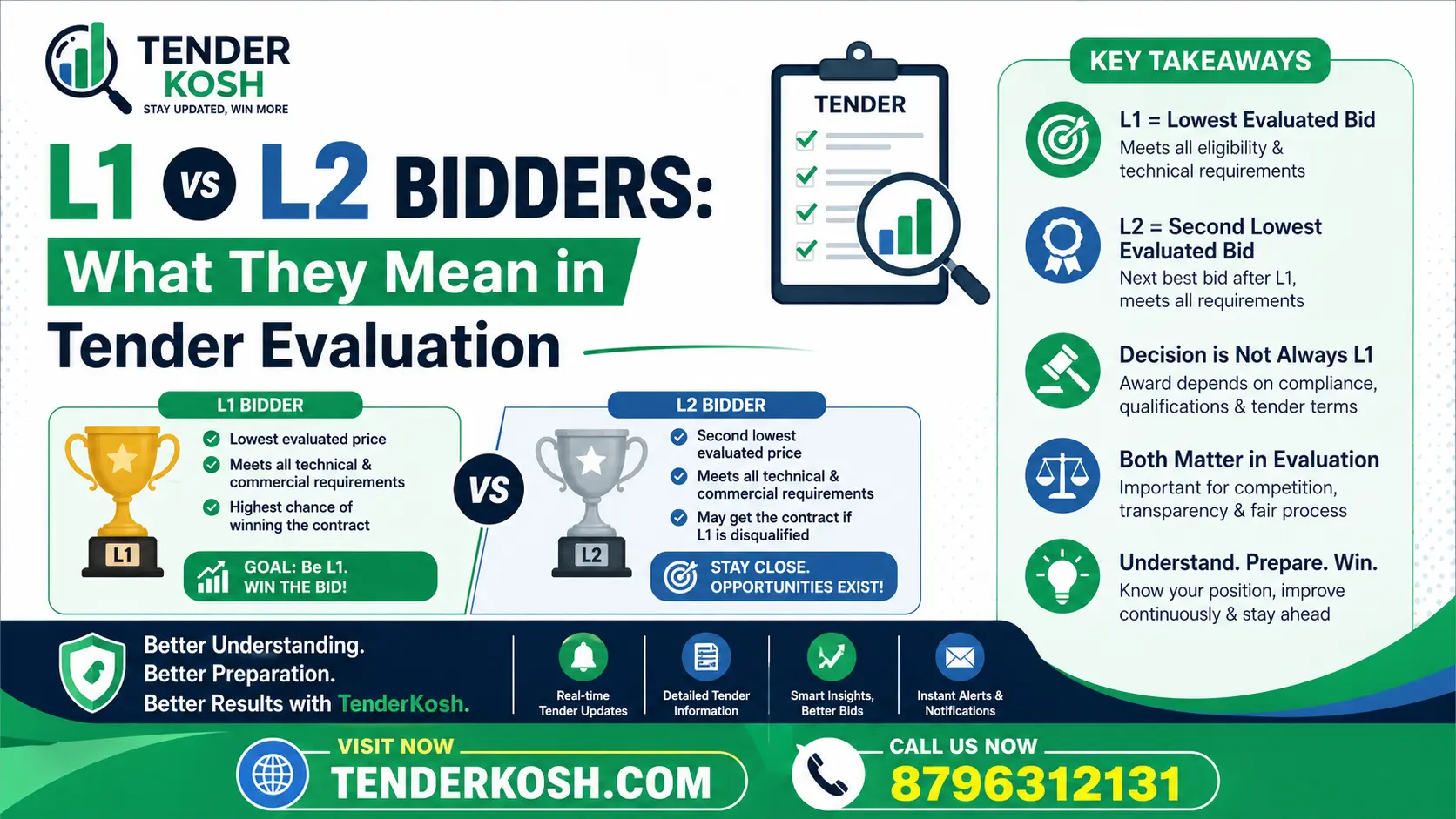
L1 vs L2 Bidders are among the most important concepts in government tender evaluation. Understanding how L1 (Lowest Bidder) and L2 (Second Lowest Bidder) work can significantly improve your chances of winning tenders.
L1 stands for Lowest Bidder — the company that quotes the lowest price among all technically qualified bidders in a tender.
Only bidders who pass the technical evaluation stage are considered for financial comparison. Among them, the lowest quote becomes L1, followed by L2, L3, and so on.
| Criteria | L1 Bidder | L2 Bidder |
|---|---|---|
| Position | Lowest Price | Second Lowest Price |
| Winning Chance | Very High | Conditional |
| Selection | Meets all criteria | If L1 fails |
| Strategy | Competitive + compliant | Backup readiness |
| Company | Quoted Price | Rank |
|---|---|---|
| Company A | ₹95 Lakhs | L1 |
| Company B | ₹98 Lakhs | L2 |
| Company C | ₹1.02 Crore | L3 |
| Company D | ₹1.05 Crore | L4 |
No. Even L1 bidders can be rejected if they fail to meet compliance, documentation, or technical requirements.
If the L1 bidder fails to sign the contract or is disqualified, the authority may move to the L2 bidder. This makes L2 a critical backup position in tendering.
Track tenders, monitor updates, and improve your L1 success rate with smart tools.
📞 Call Now: 8796312131
This article is general information, not advice. It has been compiled from publicly available sources — government releases and notifications, official portals, published tender documents and trade reporting — and reflects our understanding at the time of writing. It is not legal, financial, tax or professional advice, and it does not create any advisory relationship.
Public procurement changes constantly. Tender terms, eligibility criteria, thresholds, fees, deadlines, scheme conditions and government policy are revised frequently, often through corrigenda issued mid-window and sometimes without wide notice. Figures and rules that were accurate when published may already have changed by the time you read this.
Always verify against the primary source before you act or bid. The tender document, the issuing authority's official portal and the relevant government notification are the authoritative sources. Where anything in this article differs from them, the official source prevails. Do not rely on this page — or on any third-party summary — as the basis for a bid, an investment or a compliance decision.
TenderKosh is a private tender-intelligence platform. We are not a government body, and we are not affiliated with, endorsed by or acting on behalf of any government department, ministry, PSU or procurement portal. Names, marks and portals referenced belong to their respective owners and are used for identification only. External links are provided for convenience; we do not control and are not responsible for third-party content.
While we take reasonable care, we make no warranty as to the accuracy, completeness or currency of this content, and accept no liability for any loss or damage arising from reliance on it.Spotted something wrong or out of date? Please tell us at support@tenderkosh.com — we correct errors promptly.See our full Disclaimer.
Discover relevant tenders, monitor corrigenda, compare opportunities, and move from document reading to structured action.