TenderKosh for EPC teams
Turn tender reading into faster bidding decisions.
Discover relevant tenders, monitor corrigenda, compare opportunities, and move from document reading to structured action.
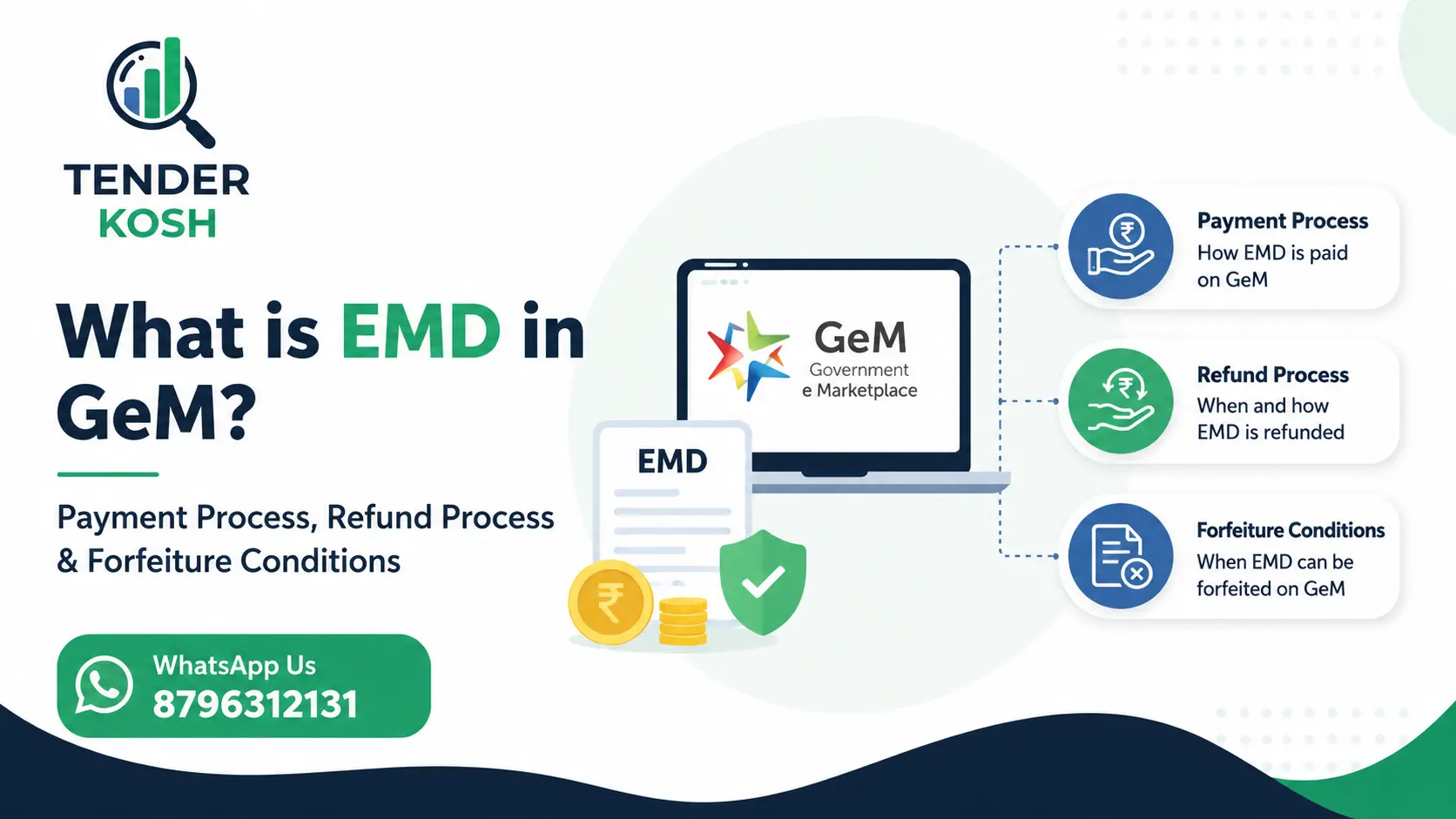
Understanding EMD in GeM is important for every supplier participating in government procurement through the GeM portal. Many suppliers lose bids, face refund delays, or experience disqualification simply because they do not fully understand how EMD in GeM works.
The rules related to EMD in GeM can directly affect bid eligibility, refund timelines, and overall tender compliance. Whether you are an MSME, startup, OEM, trader, contractor, or service provider, this detailed guide explains everything you need to know about the EMD in GeM payment process, refund system, exemptions, and forfeiture conditions.
Looking for daily GeM tender updates, corrigendums, and procurement insights? Visit TenderKosh for the latest government tender opportunities across India.

EMD in GeM refers to the Earnest Money Deposit submitted by bidders while participating in tenders on the Government e-Marketplace portal. The purpose of EMD in GeM is to ensure that only serious and genuine suppliers participate in government procurement.
Government buyers use EMD in GeM as financial protection against bidders who withdraw their bids or fail to honor contractual commitments after winning the tender.
In most tenders, the EMD amount is calculated as a percentage of the estimated tender value and usually ranges between 0.5% to 5% of the bid value.
Businesses participating in government procurement should also understand the difference between L1 and L2 bidders in tenders to improve bidding strategies.
Many GeM buyers treat EMD in GeM as a mandatory eligibility condition. Incorrect submission can directly result in technical bid rejection.
Want more government tender guidance? Explore the latest procurement resources on TenderKosh Blog.
EMD in GeM is commonly required in higher-value tenders, custom bids, and procurement projects involving significant execution risks.
Before submitting any bid, suppliers must carefully review the latest EMD in GeM guidelines mentioned in the tender document.
Understanding MSME benefits in government tenders can help businesses reduce participation costs and improve eligibility.
Certain businesses and organizations may receive exemption from EMD in GeM depending on tender conditions.
However, exemption from EMD in GeM is not automatic in every tender. Buyers may still require EMD from all participants depending on procurement needs.
Learn more about MSME tender benefits and procurement updates on TenderKosh.
The EMD in GeM payment process is relatively simple, but bidders must follow every instruction carefully to avoid disqualification.
Access your seller account and search for the relevant GeM tender.
Depending on the tender, EMD in GeM can usually be submitted through:
Complete OTP verification and submit the bid before the deadline. Many suppliers face rejection because they fail to complete the EMD in GeM process correctly.
The refund process for EMD in GeM is generally automated after tender evaluation is completed.
If your bid is not selected, the EMD in GeM amount is typically refunded automatically after completion of bid evaluation.
Refund timelines usually range between 7–15 working days depending on bank processing and buyer approval timelines.
Incorrect account details are one of the biggest reasons for delays in EMD in GeM refunds.

Businesses that understand the complete EMD in GeM process are more likely to participate successfully in government tenders.
EMD in GeM may be forfeited if bidders violate tender conditions or fail to honor contractual obligations.
Once forfeited, recovering EMD in GeM becomes extremely difficult. Suppliers should participate only in tenders they can genuinely execute.
Suppliers should regularly monitor latest government tender updates and corrigendums to avoid missing important bid changes.
Tracking updates related to EMD in GeM can help businesses avoid refund delays and forfeiture risks.
Need help with GeM bidding, tender tracking, corrigendum alerts, and procurement insights? Visit TenderKosh.com.
| Basis | EMD | Performance Security |
|---|---|---|
| Purpose | Ensures serious bidding | Ensures successful contract execution |
| When Submitted | During bid submission | After award of contract |
| Refundable | Yes | Usually after completion |
| Applicable To | All bidders | Selected bidder only |
Understanding the complete EMD in GeM process is essential for suppliers participating in government procurement. From payment methods and exemptions to refund timelines and forfeiture conditions, every step affects your bidding success.
Suppliers who properly follow EMD in GeM rules, maintain accurate documentation, and track procurement updates can significantly improve their chances of winning tenders successfully.
For daily government tender updates, bid alerts, corrigendum tracking, and GeM procurement insights, visit TenderKosh.
No. EMD requirements depend on tender value, procurement type, and exemption eligibility.
EMD in GeM generally ranges between 0.5% and 5% of the estimated tender value.
Refunds are usually processed within 7–15 working days after bid evaluation.
Yes. Eligible MSMEs with valid Udyam Registration may receive exemption depending on tender conditions.
EMD may be forfeited for bid withdrawal, refusal to accept contract, false documentation, or failure to submit Performance Security.
Accepted methods may include online payment, NEFT/RTGS, Bank Guarantee, DD, and FDR.
This article is general information, not advice. It has been compiled from publicly available sources — government releases and notifications, official portals, published tender documents and trade reporting — and reflects our understanding at the time of writing. It is not legal, financial, tax or professional advice, and it does not create any advisory relationship.
Public procurement changes constantly. Tender terms, eligibility criteria, thresholds, fees, deadlines, scheme conditions and government policy are revised frequently, often through corrigenda issued mid-window and sometimes without wide notice. Figures and rules that were accurate when published may already have changed by the time you read this.
Always verify against the primary source before you act or bid. The tender document, the issuing authority's official portal and the relevant government notification are the authoritative sources. Where anything in this article differs from them, the official source prevails. Do not rely on this page — or on any third-party summary — as the basis for a bid, an investment or a compliance decision.
TenderKosh is a private tender-intelligence platform. We are not a government body, and we are not affiliated with, endorsed by or acting on behalf of any government department, ministry, PSU or procurement portal. Names, marks and portals referenced belong to their respective owners and are used for identification only. External links are provided for convenience; we do not control and are not responsible for third-party content.
While we take reasonable care, we make no warranty as to the accuracy, completeness or currency of this content, and accept no liability for any loss or damage arising from reliance on it.Spotted something wrong or out of date? Please tell us at support@tenderkosh.com — we correct errors promptly.See our full Disclaimer.
Discover relevant tenders, monitor corrigenda, compare opportunities, and move from document reading to structured action.